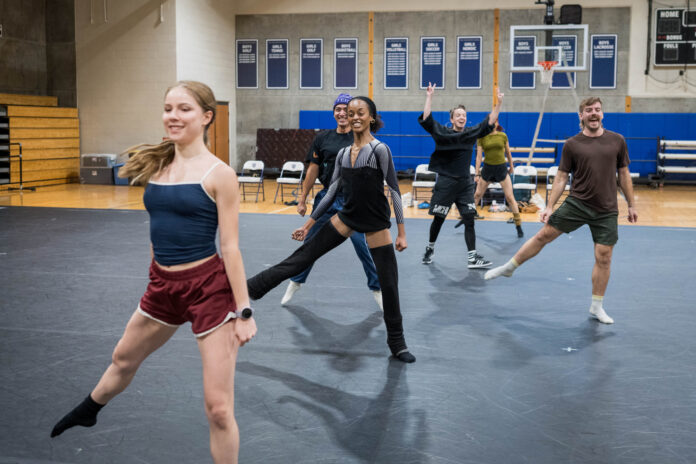
What happens when you put some of the world’s best tap, ballet, and Irish step dancers in a high-altitude dance studio together for eight days? On August 10, audiences in Vail, Colorado, will find out. As part of this year’s NOW evening of world premieres at Vail Dance Festival, tap dancer and choreographer Michelle Dorrance—a 10-year festival veteran—is creating a work with first-time VDF choreographer Chelsea Hoy, co-artistic director of Chicago’s Trinity Irish Dance Company, for a cast that also includes top New York City Ballet dancers.
Both Dorrance and Trinity Irish Dance are familiar with interdisciplinary collaboration. Dorrance frequently creates with dance artists from across the style spectrum, and Trinity has made cross-genre works for decades. They’ve worked together, too—beginning with 2020’s American Traffic and again, on SÉseacht, earlier this year. Dorrance says she’s admired Trinity since the late 1990s. “As a collaborator, but also as a fan of the company, truly, I am thrilled when I experience these artists,” she says.
What sets the Vail project apart is the addition of ballet to the mix—specifically, New York City Ballet stars India Bradley, Tiler Peck, and Roman Mejia. They join standout tap dancers Emiko Nakagawa and Dario Natarelli and Trinity’s Hoy, Maddie Cabral, Michael Fleck, Anna Gorman, and Sofia Dorantes as performers. Dorantes, in just her first season, is among the top-ranked dancers on the competitive circuit, and is currently Mexico’s winningest female Irish step dancer.
It’s a heady group to have in a single studio. “These dancers are blowing everyone’s minds,” Dorrance says.

Dorrance and Hoy are aiming to find a middle ground between each dancer’s respective form. The tap dancers are exploring the virtuosity of soft shoe and skat. The ballet dancers are finding the percussiveness inherent to petit allégro.
Interestingly, “Irish is the common denominator,” says Hoy. Irish soft shoe, she says, shares a lineage with ballet, with influence from France contributing to its movement. Percussive hard-shoe dance is more closely aligned with tap; it is a dance of resistance, carrying the rhythms and music that kept Irish culture alive following the British invasion of Ireland.
Irish dance isn’t often featured on the concert-dance festival circuit. Trinity last visited Vail Dance Festival in 1999, amid the Irish dance craze that followed the commercial behemoth Riverdance. Last summer, Trinity’s trip to Jacob’s Pillow marked the first time Irish dance got a full evening in the Ted Shawn Theatre.
“Irish has been relegated so far from the ballet and contemporary worlds of dance that still, today, we’re at the Pillow, we’re at The Joyce, but we definitely do feel that,” Hoy says. At Vail, “This is the first time I think our dancers have been, like, ‘We literally can exist on the same dance floor.’ What’s surprising to them is how much people want to learn from them.”
