
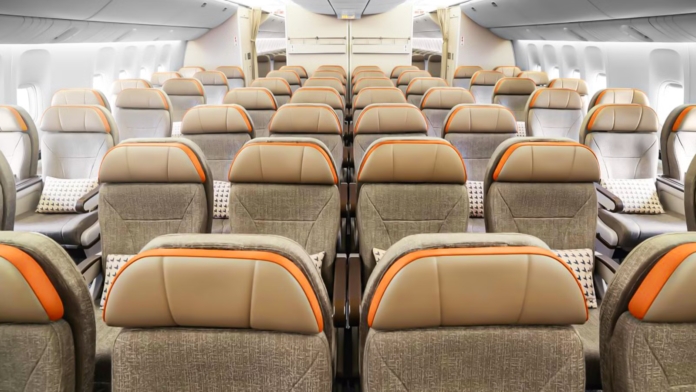
The focus on bringing back true passenger value is led by a distinct cohort of international airlines, including EVA Air, Japan Airlines(JAL) ,  Emirates, Air New Zealand, and Virgin Atlantic, that treat premium economy as a flagship product rather than a mid-cabin compromise. Bringing together generous seat space with refined dining and priority ground privileges, these carriers have elevated the passenger experience to a standard that rivals regional business class, while major US legacy operators stick to a very different pricing and positioning strategy.
EVA Air’s Boeing 787-9 Dreamliner

EVA Air demonstrates precisely where premium economy outshines business class in pure value. The Taiwanese carrier pioneered the modern mid-cabin product as Evergreen Deluxe Class in 1992, and its latest iteration on the Boeing 787-9 Dreamliner provides comfort that directly challenges the financial necessity of a lie-flat bed. By configuring its 787-9 premium economy section with an industry-leading 42 inches (107 cm) of seat pitch in a spacious 2-3-2 layout, EVA Air gives passengers significantly more personal space than standard international competitors. However, generous seat dimensions alone do not fully explain why this cabin represents such an efficient alternative to the airline’s flagship Royal Laurel Class.
What makes this product objectively better in value is the price disparity when measured against global quality rankings. In the annual Skytrax World Airline Awards, EVA Air consistently secures a top-five global ranking for its premium economy cabin, whereas its Royal Laurel business class holds 12th place in the 2025 rankings. On transpacific long-haul sectors connecting North America to Taipei, business class tickets regularly cost three to four times as much as a premium economy seat. Shelling out thousands of extra dollars for a lie-flat suite delivers diminishing marginal comfort when the mid-tier option includes 15.6-inch (40 cm) personal touchscreens, privacy headrest wings, and upgraded catering served on proper tableware.
The airline has had plenty of time to refine its premium economy product and has done so exceptionally, making it one of the standout premium economy products in the world. EVA Air relies on fixed cabin dimensions and superior hardware to build its value proposition; however, other elite Asian carriers are utilizing dynamic purchasing tools to bring the business class experience even closer to the premium economy price point.
Japan Airlines’ Sky Premium

JAL narrows the value gap by pairing world-class cabin architecture with remarkably tight price differences between cabin tiers. While competing transpacific carriers charge upwards of four times the premium economy fare for a business class ticket, JAL typically prices its long-haul business suites at two to two-and-a-half times the cost of a premium economy seat. This narrower price delta becomes even more compelling when comparing international quality benchmarks: JAL holds second place globally for premium economy in the Skytrax World Airline Awards, outranking its own eighth-place business class.
JAL’s value proposition centers on the JAL Sky Premium seat, which offers 42 inches (107 cm) of seat pitch and an 18.9-inch (48 cm) width. The seat uses a fixed-shell design that slides forward within its own housing rather than reclining backward, ensuring the passenger in front never encroaches on the legroom or the 12.1-inch (30 cm) entertainment screen behind. Ticket holders also receive complimentary access to JAL Sakura Lounges at select airports and access to the carrier’s official Bid Upgrade program. Up to 36 hours before departure, premium economy passengers can submit cash bids to capture unsold business class suites, giving them the chance to get a lie-flat bed at a fraction of the full published fare.
Asian legacy carriers like JAL have built their premium economy reputation over decades of incremental hardware refinements, but Gulf megacarriers long resisted introducing a mid-tier cabin, concerned it would overlap with high-margin business class sales. However, explosive demand for mid-tier luxury eventually forced a complete strategy change even among the industry’s most conservative operators.
Emirates’ Premium Economy

Emirates long resisted introducing a mid-tier cabin, concerned it would dilute high-margin business class revenue. However, the Gulf carrier shifted strategy after President Sir Tim Clark admitted he was “shocked at the demand” for the product. Passengers showed an immediate willingness to pay higher fares for extra space, trading up from standard economy without eroding business-class yields. To capture this segment, Emirates launched an extensive fleet retrofit program across its Airbus A380 and 777-300ER aircraft, transforming its cabin economics by monetizing the space between economy and business class.
Catch what other flight trackers miss
Emergency squawks, holds, NOTAMs — live signals, no signup.
Open tracker
Catch what other flight trackers miss
Emergency squawks, holds, NOTAMs — live signals, no signup.
Open tracker
The product includes a customized Recaro seat platform wrapped in cream leather upholstery and wood-veneer trim, echoing the airline’s luxury brand identity. With 40 inches (102 cm) of pitch and a 19.5-inch (50 cm) width, Emirates introduced six-way adjustable headrests, padded leg rests, and 13.3-inch (34 cm) high-definition entertainment screens. This attention to hardware earned Emirates the Skytrax World Airline Award for the World’s Best Premium Economy Seat. Emirates offers seat dimensions and finishing touches that truly rival older regional business class cabins, in a product where upgrading to business class adds very minimal comfort gains relative to the price increase.
Emirates has proved that Gulf luxury can be adapted into a mid-tier seat, and other airlines are looking to follow suit, a massive contrast to what Western and Pacific carriers face, as there is a different commercial dynamic where corporate travel budgets heavily influence pricing. On long-haul transatlantic and transpacific routes, corporate demand regularly inflates business class fares, making premium economy an even more attractive alternative for cost-conscious organizations and independent travelers.
Virgin Atlantic’s Premium

Corporate travel policies on high-density long-haul corridors have created somewhat of an artificial price floor for business class, with fares inflated by corporate accounts that automatically select lie-flat seats for executive travel. On transpacific routes connecting Auckland to North America or transatlantic sectors linking London to New York, corporate demand drives business class prices up to three or four times the cost of premium economy. For independent business travelers and cost-conscious corporate travel managers, paying upwards of $6,000 for a lie-flat suite when a mid-tier ticket costs under $2,000 is an inefficient allocation of capital, prompting a structural shift toward high-spec premium economy cabins.
Air New Zealand and Virgin Atlantic have capitalized directly on this corporate price disconnect by engineering premium economy cabins that outperform their respective business class offerings in relative value. According to The Sydney Morning Herald, Air New Zealand equips its 787-9 and 777-300ER widebody fleet with a generous 41-inch (104 cm) seat pitch, leather recliners, and Kiwi-inspired dining, while its older Business Premier cabin misses the Skytrax top twenty. Meanwhile, Virgin Atlantic, the winner for world’s best premium economy airline overall in the 2025 Skytrax awards, uses customized seats on its A350-1000 and 787-9 aircraft. As detailed by Head For Points, the airline offers 38 inches (97 cm) of legroom, dedicated airport check-in, and priority baggage handling; Virgin Atlantic delivers the core productivity benefits that business travelers require without making companies pay inflated corporate business class fares.
More recently, corporate travel departments have been revising policy guidelines to permit premium economy bookings on long-haul flights under 10 hours; as a result, international airlines are experiencing a major realignment in passenger yields. This commercial shift is pushing airlines to reallocate cabin floor space, expanding premium economy sections at the direct expense of standard economy rows. However, while Asian, European, and Pacific carriers aggressively market these mid-tier cabins to capture shifting corporate budgets, major US legacy operators continue to take a radically different approach to cabin segmentation.
Premium Economy In The US

 American Airlines,
  Delta Air Lines, and
  United Airlines do lag quite considerably behind their Asian and European peers because they view premium economy primarily as an extra-space upsell from standard economy rather than a junior business class experience. While international leaders invest heavily in fixed-shell privacy, multi-course dining, and lounge access, US legacy operators treat their mid-tier cabins, branded as Premium Select on Delta, Premium Plus on United, and Premium Economy on American, as a domestic first class recliner placed on a widebody jet. Furthermore, heavy reliance on corporate business class contracts and domestic upgrade programs incentivizes US carriers to protect their top-tier cabins, pricing premium economy at a lower baseline while offering fewer exclusive amenities.
The differences become immediately clear when examining widebody seat geometry across transpacific and transatlantic routes. Where carriers such as JAL and EVA Air offer up to 42 inches (107 cm) of pitch, American, Delta, and United standardize on a 38-inch (97 cm) baseline, with seat widths ranging from 18.5 to 19 inches (47 to 48 cm). Onboard catering often consists of single-tray meals adapted from main cabin menus rather than multi-course dining served on linen, and airport privileges are limited to priority check-in and security acceleration rather than complimentary lounge entry. US airlines maintain a clear divide between main cabin seats and flagship business suites like Delta One or United Polaris, unlike many carriers worldwide.
As global travelers become more discerning regarding long-haul comfort, the product gap between domestic legacy carriers and foreign rivals creates a growing commercial divide on competitive international routes. Offering modest recliner seats with minimal soft-product differentiation risks alienating premium leisure flyers who want an upgraded experience without paying four times the fare for a lie-flat bed. At this point, how long can US carriers maintain their current cabin strategy as international competitors set higher standards for mid-tier luxury?
The Future Of Premium Economy

International airlines are racing to install increasingly complex, heavy business class suites equipped with sliding privacy doors and customized mechanics, which means the capital cost per square foot in the front cabin pushes ticket prices higher. This inflation creates a permanent market opening for premium economy to serve as the default long-haul choice for self-funding travelers and corporate departments unwilling to absorb three-to-fourfold fare markups.
Whether premium economy permanently establishes itself as the smartest buy across global long-haul networks will depend on widebody delivery streams and fleet retrofit schedules through 2027. With the cabin interior retrofit market expanding toward $38 billion, the key indicator to monitor is how carriers allocate floor space on incoming A350, 787, and 777-9 deliveries. If airlines continue expanding mid-tier footprints by carving out space previously dedicated to standard main cabin rows, as seen in multi-billion-dollar retrofit programs that trade standard economy seats for 40-inch (102 cm) recliners, it will confirm that the industry is yielding to where passenger demand actually sits.
Will legacy US carriers finally upgrade their basic recliner hardware to compete with Asian and European rivals? Only time will tell, but if nothing changes quickly, international leaders will permanently capture the market of discerning flyers who recognize that mid-cabin recliners offer all the comfort they truly need.
