
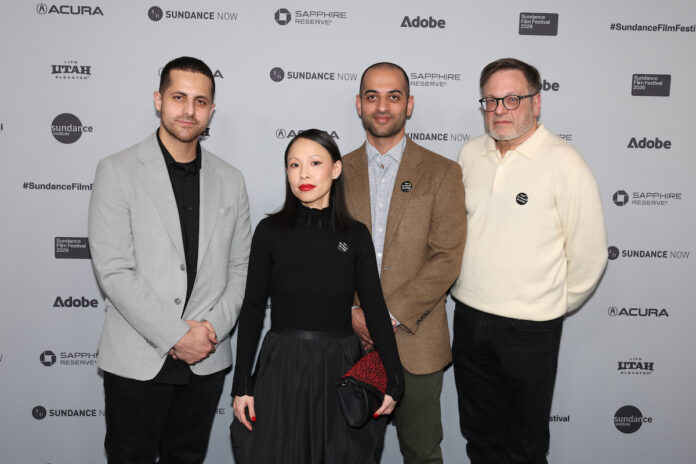
The three American doctors profiled in the film have different approaches to the way they speak out — at events, to the media, to elected officials — about what they’ve seen. “You can be like Dr. Thaer: politic, strategic, gets things done,” says Teng. “You could be like Dr. Mark Perlmutter: never minces words. Or you can be like Dr. Feroze Sidhwa, who does all the homework and provides the context to convince the most difficult of audiences.” And there’s a lot of convincing to be done, much of it ending in feelings of futility when the doctors are met with indifference or repeated disinformation, like assurances that a hospital was only damaged because of the Hamas-created tunnels that operated beneath it — tunnels that Dr. Sidhwa knows to be fictional.
These scenes provide a jarring contrast to the film’s graphic footage on the ground in Gaza, where an apocalyptic setting surrounds the Nasser Hospital. Inside, doctors must decide whom they can attempt to save while they are presented with an overwhelming number of patients with woefully insufficient medical supplies on hand. These moments are difficult to watch, and made all the more difficult when the hospital is later targeted by multiple Israeli airstrikes that kill children, health workers, and journalists.
It’s enough to make one feel discouraged, absorbing repeated acts of violence and seeing no repercussions for the perpetrators. Even Dr. Ahmad — who nevertheless continues to act on his duty of care — admits to feeling dejected. “I’ll be honest, when Poh started working on this [film], I was always mentioning something to her. I said, ‘I really hope it’s worth all of your time and effort and the entire team that put this together.’ I just felt like people would not be interested in hearing this,” he tells the audience during the Q&A.
“And that was just being a Palestinian, being born and raised during the First Intifada, the Second Intifada, so on and so forth, all of the different aggressions on Gaza — I just was resigned to the fact that this was not gonna be something that people felt was important or wanted to hear,” he continues. “And seeing this film and even seeing people in this audience, to me, inspires me to keep moving forward, because there are so many moments when you just feel so deflated, and you feel like nothing is giving, and you’re just trying so hard. And then you see something like this,” he says, gesturing to the audience.
Dr. Perlmutter also recognizes the power of a film like American Doctor to shine a light on truth and encourage small actions that lead to bigger ones. “This film can save hundreds of thousands of children,” he says, “By just stimulating, maybe swaying one vote” — getting one more individual elected who would object to funding additional weapons for Israel.
Because there is still work to be done. Truckloads of food and medical supplies are being turned away from the border — even when it was officially open, says Dr. Perlmutter — and the people of Gaza continue to starve and die from preventable infections.
“[The U.S. Civil Military Coordination Center] is supposed to be coordinating the entry of free building supplies, humanitarian aid, and things like that, and taking that out of the hands of the Israelis,” says Dr. Sidhwa. “Clearly it hasn’t done that. But right now what we’re seeing is the Israelis are allowing some limited amount of medical supplies to come in, but only going to NGOs and field hospitals, basically denying the ministry of health in Gaza — the only thing that the Palestinians actually run — the right to rebuild, actually treating anybody in any way they can. So you know, again, even though there’s what the whole world insists on calling a ceasefire going on, there’s still this implementation of systematic denial of Palestinians’ not only right to receive health care, but just right to control their destiny in general.”
