
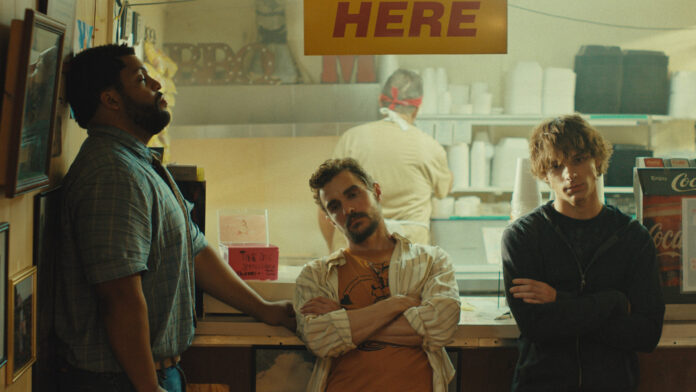
The sparks of dialogue in certain fast-paced scenes felt so natural. Was everything kept strictly scripted or was there room to improvise?
I think there was a little bit of both. We tried in a lot of cases to stay tight to the script, because everything was organized to get us to the next beat. But I also knew I’d be foolish not to take advantage of these actors, because they’re all so good at spontaneously adding things, and it reflects well on the whole movie. The middle section is a bit of a detective story, so we didn’t have a lot of room to veer into far-off tangents, but since the whole movie is basically the two guys arguing, letting them just argue was a big part of it. That texture is almost impossible to script. It’s got to be people talking over each other, sputtering, not saying their words correctly, being messy and a little incorrect. I tried to make sure they had space to try stuff like that, and a lot of it ended up in the movie.
I really like movies where the dialogue is going so fast that you almost feel like you might have missed something, and it’s kind of OK if you did. It’s not necessarily about the words being said — it’s more about the vibe in the room of two people shouting over each other. When Dave and O’Shea get into their first big fight in the hotel room, I would just let them go, because they’d keep finding new ways to one-up each other and insult each other. You only really hear about 60% of it, but it’s still so charming and funny, because it’s two guys who can’t relent, so they keep trying to have the last word. “Well, you did___,” “Well then you did___,” and it keeps going like that. The sound of their voices is the payoff, not the words themselves.
Dave Franco and O’Shea Jackson Jr. really are dynamite together. What was that casting process like?
Dave was the first one we went to, and he immediately said, “I just worked with O’Shea; you should go check with him.” I loved O’Shea in Straight Outta Compton and Ingrid Goes West, and I thought he’d be great as the stern one to Dave’s goofball. What I wasn’t prepared for was how vulnerable he can get at the drop of a hat. There was a scene where his character is in a lot of trouble and feels bad. I gave him the set-up, he said, “Got it,” and we rolled, and he instantly started crying. I was like, “What is going on?” That happened about four other times during the shoot — he just had layers going on I wasn’t aware of, and we saw them happen in real time on set. As soon as that started happening, everybody got really excited, like, “Oh, it’s a real movie.” Dave and O’Shea were a great pair, and because they were buddies who knew each other, they had real chemistry — the whole movie is them bickering, and if that hadn’t worked, the movie wouldn’t have worked. The whole thing was riding on them, and we got very lucky.
How did you get into filmmaking?
I wasn’t really ambitious in any direction other than movies. That came from my parents taking me to the movies when I was very little — it made a huge impression on me, starting to understand that it’s not just pictures on a screen, that there are people writing the words, doing the makeup, figuring out the costumes. I’d get little kids’ books like Movie Magic, and that was mesmerizing to me. Around that same time, home video cameras started to be available, so a buddy’s mom got one and we got our hands on it and made our own movies. That dominated a lot of growing up — getting the group of friends together on weekends to make movies. At some point it was just, “Oh, this is what I want to do for a job.”
I didn’t have a precise strategy, and I was interested in a lot of things — I really liked acting, but I also loved writing, because I could just sit down at my desk and do that without having to audition. Making my own movies felt very far away — something I could get to eventually. It was kind of like, “I’ll take anything that’s movie-adjacent.” My friends and I moved up to New York around the same time, and I got jobs as a production assistant while Jeremy [Saulnier] was starting to work as a director of photography, and little by little we were trying to figure out how to own that and make our own projects. It took a while and a lot of resets, but that was always the goal from a very young age.
My mom, by the way, was very supportive, especially when we were little. She put a huge amount of emphasis on creativity, always telling us to get out of the house and go do something creative. I think that’s probably part of it. But she was also a mom, and when I was getting to be in my late 20s, early 30s and still basically a PA with no health insurance, she was kind of like, “What the fuck are you doing?” And I was always like, “It’s just a few more years and then we’ll figure something out.” But there wasn’t really a backup plan.
