
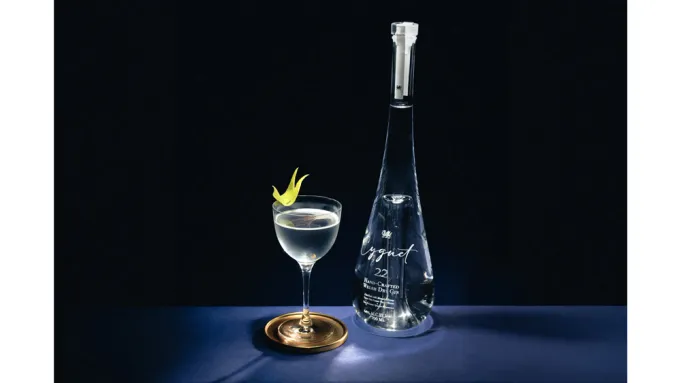
The cocktail universe is incredibly diverse, ranging from simple two-ingredient highballs to complex miracles of science employing laboratory-created ingredients that do everything from bubble to smoke. But at the center of it all, the martini endures. Its distinctive long-stemmed glass with the conical, V-shaped bowl is the universally recognized icon representing all cocktails. And no other cocktail arouses such passionate debate around how it should be made: shaking versus stirring; the correct amount of vermouth; olives or twist; and so on, with even the slightest variation grounds for vigorous discussion.
The martini’s popularity waxes and wanes, but it never goes out of style for long. And in the 2020s, its popularity has surged into overdrive. High end bars worldwide now offer tableside martini service, and martini menus feature ever-swelling variations on the classic theme. Why now? For starters, we live in a time where quiet luxury is appreciated and valued. Understatement rather than flash, over-the-top ditched in favor of restraint. No other cocktail speaks to that mindset the way a martini does. At the same time, there’s also a greater appreciation for craftsmanship, technique, and expertise. A great martini requires precision, attention to detail, and perfectionism, in the mixing, the proportion of the ingredients, and most importantly, the choice of ingredients themselves.

Courtesy of Cygnet Gin Distillery
That emphasis on precision and detail is where the martini and Cygnet Gin naturally converge. “The martini is one of the few cocktails where there is nowhere to hide,” says Vedran Milosevic, Cygnet’s global managing director. “Every element has to be right. It is a drink built on precision. That is exactly how we think about Cygnet. We obsess over every detail, from the ingredients we source and the way we distill our liquid, to the design of the bottle and the experience of serving it. Every decision is deliberate because, in the end, the smallest details make the biggest difference.”
Invented in America, Perfected in England
The martini’s origins are murky and subject to debate, but there’s little doubt that it is an American creation. Some cocktail historians have it evolving from the Martinez cocktail, which was popular on the West Coast in the second half of the 19th century. Employing sweetened Old Tom gin, sweet vermouth, and maraschino liqueur, it bears only the most tenuous relationship to the modern version. But by the early 1900s, innovative bartenders in New York and elsewhere had begun to transform it into the dry, crisp martini we know today. Sweet vermouth was switched out for dry, and most importantly, the de facto gin used was now London Dry — crisp, bracing, with a juniper backbone.
Thanks to London Dry Gin, the martini, though created across the pond, is forever identified with England. Some of the world’s most famous martinis have been made there, from the American Bar at the Savoy—where Harry Craddock codified the Dry Martini in his classic Savoy Cocktail Book in 1930—to the Connaught, which pioneered martini trolley service, and Dukes, where new dimensions of purity and coldness were reached.

Courtesy of Cygnet Gin Distillery
Cygnet Gin: A Classic London Dry…That Breaks a Few Rules
As the martini has evolved over the decades, different gins have come into and out of fashion. But in the pantheon of London Dry gins, Cygnet Gin stands apart. It’s a classic London Dry but with modern sensibilities; its botanical mix includes outliers like chamomile and, most notably, Manuka honey, which contributes texture and softness without also adding sweetness. Its sustainably produced decanter is one of the most recognizable bottles in the spirits industry. Launched just three years ago by a team including renowned classical vocalist Katherine Jenkins, OBE; Andrew Levitas, filmmaker, visual artist, and environmentalist; and sixth-generation distiller Chris Sadler, it’s now the now the No. 1 British Ultra Premium+ gin brand in the U.K., and No. 2 in the gin segment overall.
Cygnet was created to be a sipping gin, and so, it makes sense that a gin designed to stand alone so completely would find such a natural expression in a martini. It’s a cocktail that magnifies a gin’s strengths…or emphasizes its shortcomings. Cygnet’s distinctive botanical mix makes a martini that stands out from the rest. “The 22 carefully selected botanicals, including Manuka honey, give the gin a character unlike any other,” says Jenkins, “It creates an incredibly smooth, rounded texture and exceptional balance, allowing the botanicals to work in harmony.” That harmony makes all the difference—Cygnet 22 delivers a martini with remarkable smoothness, depth, and elegance that is difficult to match.

Courtesy of Robb Report
Education as Ritual
The bespoke martini has always been a part of martini culture. But at bars in decades past, that rarely extended beyond requests for varying degrees of dryness. Nowadays, the situation has changed, with tableside martini service in many high-end bars providing a more bespoke, individualized experience. That same philosophy extends beyond the glass. Rather than reinventing the martini, Cygnet’s evolving hospitality programs, like the Martini Concierge, invite guests to appreciate how the smallest adjustments in aroma or garnish can reveal different dimensions of the same uncompromising spirit.
A Martini Fit for Royalty
Cygnet’s signature serve, fittingly dubbed the Queen’s Cygnature Martini, mixes a dash of both old and new into the standard formula. Along with gin and dry vermouth, it features orange bitters—an essential martini component in the early 20th century that was rediscovered and newly embraced a century later—and a whisper of elderflower liqueur, which took the spirits world by storm in the early 2000s and became an essential ingredient for bartenders in short order. Gabriele Sasnauskaite, Cygnet’s head of culture and advocacy, developed the cocktail with founders Jenkins and Levitas. “Elderflower as a taste is very common in the UK, so I wanted to celebrate this beloved flavor,” Sasnauskaite says. “It also compliments Cygnet’s Manuka honey notes and the bouquet of flowers like rose petals, heather, hibiscus, and calendula that we use to distill our gin.”
Martini purists, who consider anything apart from gin, vermouth, and orange bitters to be heretical, can be a vociferous bunch, but Sasnauskaite respects their passion. “I love the purists because they protect the history and ritual of the martini,” she says, “and there is something undeniably beautiful about the classic combination of gin, vermouth and bitters.

Courtesy of Cygnet Gin Distillery
“But cocktails have always evolved,” she adds. “If we stopped at the original recipes, we wouldn’t have half of the drinks we now consider classics. For me, a martini is as much about an experience and a style of drinking as it is about a fixed formula: cold, elegant, spirit-forward, and beautifully balanced. Creating Queen’s Martini, I didn’t turn away from a classic recipe, I wanted to add elderflower to elevate it and bring new experiences to martini lovers.”
The elderflower harmonizes beautifully with the botanicals, elevating the drink while keeping it squarely in the martini family, and enhancing the cocktail rather than transforming it. The Queen’s Cygnature Martini made its American debut at the 2026 King’s Trust Gala at Christie’s in New York—one of the most prestigious and culturally significant evenings in recent history, with Their Majesties King Charles III and Queen Camilla in attendance.

Courtesy of Cygnet Gin Distillery
The martini, like no other cocktail, straddles the line between timelessness and trendiness. Cygnet’s Jenkins, says, “The martini has never really belonged to a moment. It belongs to a standard. Trends come and go, but beautifully made things always find their way back. That was very much our philosophy with Cygnet. We wanted to create a gin with enough character and balance to stand confidently on its own, because true craftsmanship should feel timeless, whether you’re sipping it neat or enjoying it in a Martini.”
Anyone can make a Martini, but it takes skill and experience to make a truly excellent one. That skill includes choosing the right gin. Milosevic notes, “Rather than masking a spirit with lots of ingredients, the martini allows [the] gin to be the star of the show, which is why the quality of the liquid matters so much.” Cygnet wasn’t created with the intention of making a great martini, but it was created to be a great gin. Tasted neat, in a classic martini, or in a Queen’s Cygnature Martini, that greatness is evident from first sip to last.
