
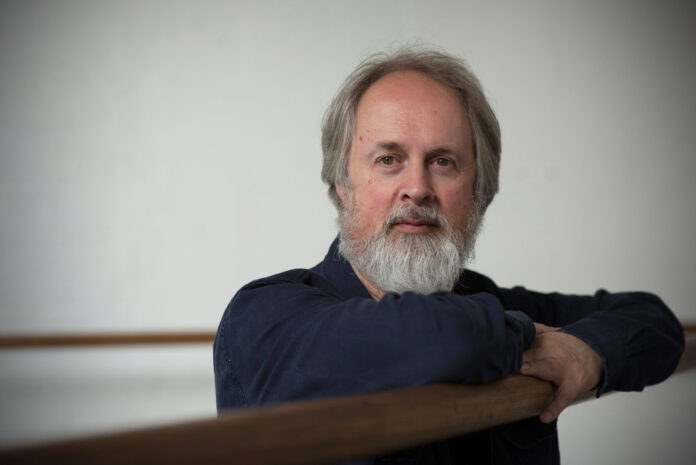
Sir Richard Alston, who has died at the age of 77, was witness to the very beginnings of contemporary dance in the UK and instrumental in shaping the then-nascent art form. He went on to become one of the country’s best loved choreographers, as well as artistic director of Britain’s oldest dance company, Ballet Rambert (1986–92), and Richard Alston Dance Company (1994–2020).
Alston’s name became synonymous with a brand of deeply musical dance. He found empathy and nuance in his carefully chosen scores, whether Johannes Brahms’ piano music (Waltzes in Disorder, A Sudden Exit), the vocal works of Benjamin Britten (Illuminations, Rejoice in the Lamb), or Steve Reich’s minimalism (Roughcut). His dancers moved with energetic focus and elegant lyricism, in fleet jumps and lilting curves, the craft of choreography always evident.
By the 21st century, Alston was one of British dance’s establishment figures—he was awarded a knighthood in 2019—but his dance career began in the fizzing experimental energy of 1960s London. Alston went to the famous boarding school Eton College, but rather than follow his contemporaries into business and politics, he took a left turn to art school. Meanwhile, he was buying cheap seats to see The Royal Ballet. Dance became an obsession.
“I decided, this is what I want to do, put my pencil down and put on some tights and get moving,” Alston told The Guardian in 2019. When Martha Graham dancer Robert Cohan arrived in London in 1966 to teach at what became London Contemporary Dance School, Alston was one of his first pupils.
Choreographer Siobhan Davies, a contemporary of Alston’s, remembers him in those days reading books while everyone else warmed up, and pointing out churches designed by English Baroque architect Nicholas Hawksmoor when they walked around London. “I could recognize then his interest in architecture, in space particularly, in sculpture, proportion, structure,” says Davies.
Alston made his first dances for his fellow students before forming the dance company Strider in 1972 . Its radical works looked to the American avant-garde, with Merce Cunningham as an important influence. In the mid-’70s Alston went to New York City to study with Cunningham and, in 1976, Alston performed his UnAmerican Activities at the Cunningham company’s Westbeth studios, with Cunningham present. Davies was among the dancers. “Merce liked the piece,” she remembers. “He congratulated us, which was unusual, apparently. Richard was cock-a-hoop!”
Another foundational influence was English ballet choreographer Frederick Ashton, visible in Alston’s swift footwork and employment of the back. “Ashton’s use of music, and use of small steps, varying the volume, making a large grand gesture and then a small sliding thing, all these small phrases, that’s home ground to me,” Alston said in a 2004 interview with Dance Now. “It made me realise I couldn’t pretend to be a sub-Cunningham.”
Alston led Richard Alston and Dancers from 1978–80, then formed Second Stride (with Davies and Ian Spink) in 1982, before becoming resident choreographer and eventually artistic director at Rambert during a richly creative period. Across the course of his career, Alston also made works for Royal Danish Ballet, Ballet Atlantique, Holland Dance Festival, Ballet Theatre Munich, Scottish Ballet, Phoenix Dance Theatre, and Ballet Black.
Alston began choreographing for New York Theatre Ballet in 2011, and its founder Diana Byer appointed Alston resident choreographer of the company in 2020. She “fell in love immediately” on seeing his work, she says: “It wasn’t about acrobatics, it wasn’t about showing off technique. It was about dancing. He had real movement vocabulary and knew how to use it in a way that spoke to the human condition.”
Alston will be remembered for his musicality and finely crafted choreography, but also for his warmth, gentle intelligence, and curiosity—“his attention to people, his joy in other people,” as Davies puts it. “He was hugely kind and wickedly funny.”
The dance world was up in arms when Alston’s company was forced to close in 2020 amid funding troubles. Speaking to The Guardian about it in 2019, Alston himself was characteristically sanguine, enjoying the response to the company’s farewell tour. “The audience went wild…, which was exciting,” he said. “I think it’s partly because they’re beginning to understand that we won’t be here forever.”
