
What was the biggest inspiration behind Night Nurse?
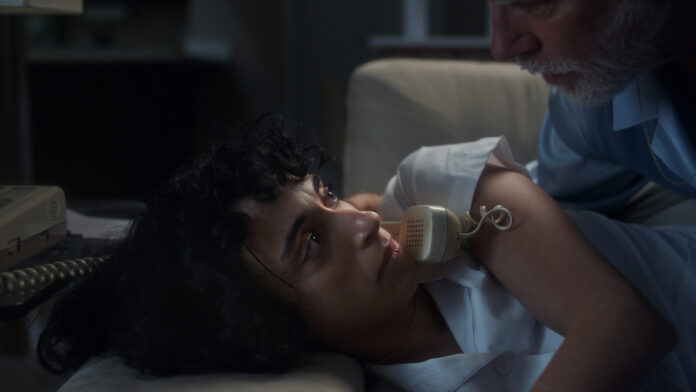
Toward the end of her life, my grandmother was getting a lot of scam calls, but only one of them actually managed to lure her to the bank. The caller impersonated my brother — said he’d been in a terrible accident and needed help. He told her she was the only person he could trust. The bank teller stopped her before she could wire any money, but I kept thinking about the strangely intimate performance of the scammer, and how underneath every fake crisis, there is a real one.
Describe who you want this film to reach.
Everyone except medical professionals.
Tell us an anecdote about casting or working with your actors.
When I wrote the film, I had someone in mind for almost every role. We were making this on such a low budget that almost every choice felt driven by practicality: we shot in my grandmother’s house; her friends became our background actors; her neighbors helped make sure no one called the cops on us. It was a bit of a family affair.
On paper, that practicality seemed to extend to casting Cemre Paksoy as our lead. She’s one of my closest friends and I wrote the role with her voice in my head. But her actual performance is anything but practical. It’s instinctive, emotional, alchemical. She brought something to the film that I could never have anticipated or engineered ahead of time.
What was your favorite part of making Night Nurse? Memories from the process?
Very early on, my DP Lidia Nikonova joked that she was “born to shoot lusting nurses,” and that spirit somehow radiated through the whole team. Those moments of collective alignment — when everyone felt a little delighted and a little possessed by what we were making — were the best part.
What was a big challenge you faced while making Night Nurse?
Realizing that the movie was a fun-house-mirror of my life.
Why does this story need to be told now?
I’ve heard rumors that erotic thrillers are making a comeback. We’re just giving the people what they want.
Tell us why and how you got into filmmaking.
I thought I wanted to be an actress. Then, in college, a very old-school theater teacher did me a favor and told me I wasn’t any good, which made me feel simultaneously crazy and also a little relieved. I started directing shortly after that, but for a long time I was embarrassed to say I wanted to make movies. I thought it sounded delusional, but eventually I had to let that go. When you’re making a movie, everything is working against you, so you might as well get out of your own way.
If you weren’t a filmmaker, what would you be doing?
Failed actress.
What is something that all filmmakers should keep in mind in order to become better cinematic storytellers?
I can’t pretend to know! But I do think one of the best things you can do is work with your friends.
Who are your creative heroes?
Catherine Breillat. I wish I could talk about filmmaking like her, but unfortunately I’m not French.
What was the last thing you saw that you wish you made?
Contempt. The score alone is so tragic it’s enough to ruin your day.
One thing people don’t know about me is _____.
I love to talk on the phone.
Which of your personal characteristics contributes most to your success as a storyteller?
Middle child.
Who was the first person you told when you learned you got into the Sundance Film Festival?
I called Cemre. We cried together and then entered a state of panic.
