

As a child, Jeff Mangum experienced recurring lucid dreams – nightmares, really – of a bomb hurtling towards him. He’d always manage to wake himself up right before it hit, but in the morning light his hands felt huge and the bed seemed as hard as concrete. In others, he’d see spirits moving through walls or giant bugs crawling on the floor. One time, in a hotel in Amarillo, Texas, he realised he’d been sleepwalking and came to while standing on top of the sheets, staring at what looked like spotlights making popping sounds. This is an insight into the unquiet mind that plagues the chief architect of Neutral Milk Hotel.
In early 1995, days before he was due to fly to Denver to record debut album On Avery Island with boyhood friend and musical co-conspirator Robert Schneider, Mangum walked around his hometown of Ruston, Louisiana, with a curious preoccupation on his mind: would the world make more sense if he knew the entirety of its history, or would it merely make him insane?
Concluding it would most certainly be the latter, he retreated to a bookstore in an effort to distract himself from such impossible thoughts, picking up a copy of Anne Frank’s The Diary Of A Young Girl. So consumed was he by the implicit sadness of the teenage holocaust victim’s story that he spent the next three days crying. Suddenly, songs were demanding to be written about it. And 50 years on from the end of the second World War, the seeds of In The Aeroplane Over The Sea were sown in the most unlikely of sources.
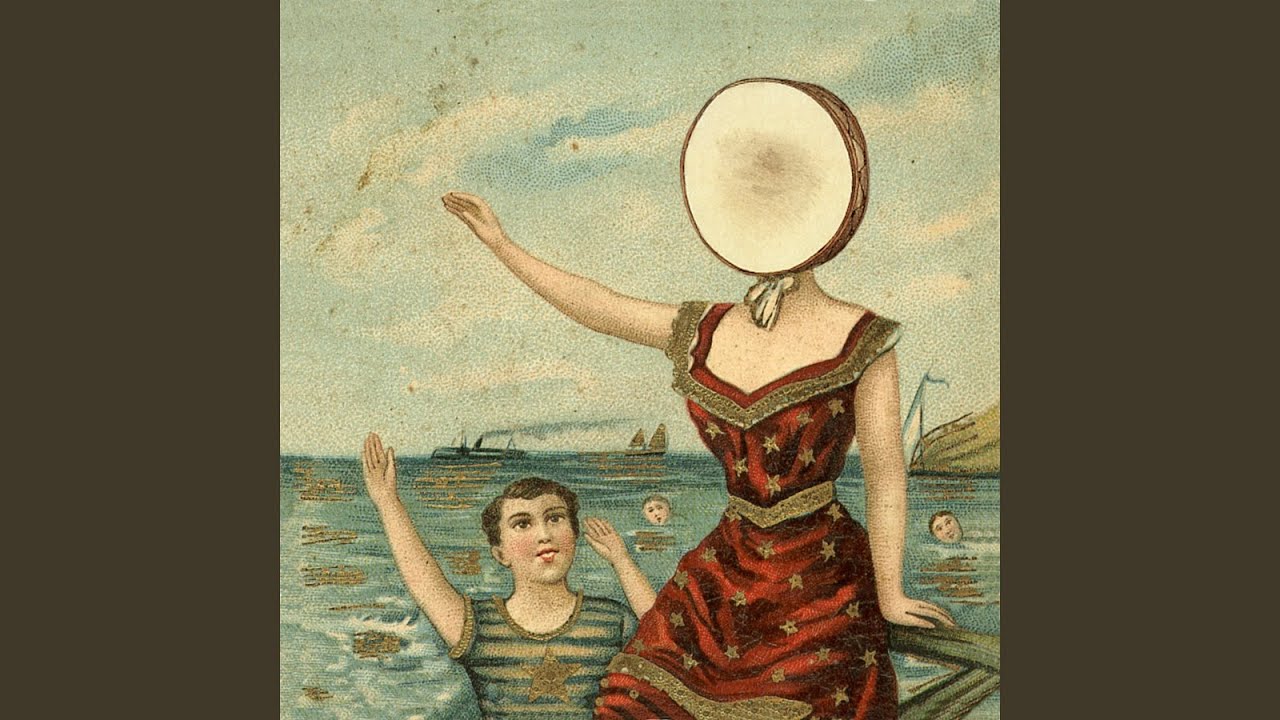
By the time those songs were nearly ready for the world’s attention, Neutral Milk Hotel’s number had already expanded for touring purposes, enlisting the help of various Elephant 6 contemporaries: a boisterous, lo-fi collective renowned for wild live shows and a shared appreciation for bygone sounds, landing somewhere on the psyche-meets-pop scale (think The Beach Boys reimagined by Pavement).
Having earned modest critical praise and shifting 5,000 copies in the UK, the folky burble of On Avery Island was deemed a success by the label, Merge Records (Superchunk, Magnetic Fields). Buoyed, Mangum decided to go bigger still on the ideas that had been spinning around in his head for the past two years. They would become part of a loose concept album, he decided, but a deeply personal one, rooted in universal themes like love, yearning, innocence, trauma, faith, and existential angst. In preparation, Mangum, guitarist Scott Spillane and drummer Jeremy Barnes moved into bassist Julian Koster’s grandma’s house in New York City, where they were convinced, they weren’t alone.
“We thought we had a ghost living in the bathroom,” Mangum told Puncture magazine in December 1997, two months before the album’s release. “So, I locked the door and started trying to sing [the song Ghost] to the ghost. But then that was sort of like singing about the ghost that we thought was constantly whistling in the other room that kept waking me up, and then a ghost that may or may not live within myself. And it also ended up being more of a reference to Anne Frank. A lot of the songs are about her.
“I would go to bed every night and have dreams about a time machine. Somehow, I’d have the ability to move through time and space, and I’d save her. Do you think that’s embarrassing?”
Latest Videos From Louder

To flesh out these strange new songs, the quartet favoured equally strange new instrumentation. Alongside traditional drums and guitars, they’d feature a singing saw, bowed banjo, uilleann pipes, flugelhorn, euphonium, and probably even the proverbial kitchen sink, so enamoured were they by the process of musique concrète (the capture of raw, real-world sounds). Once the band had saved enough money from touring the debut, they finally flew to Schneider’s Pet Sounds Studio – a former fish processing plant – where the producer experimented with direct to tape recording techniques, utilising heavy compression and creative distortion methods, giving everything a warm, layered quality.
The fruits of their collective labour make for a listening experience unlike many others. To do so is to visit a particularly disorienting world, one in which Mangum pulls the curtain back on many of his hallucinations and night terrors. Freakshow imagery abounds, with tales of mutated children preserved in formaldehyde (Two-Headed Boy). The surrealistic Communist Daughter imagines cars careening from clouds and semen covered mountain tops. Ghost and the cacophonous fuzz of Holland 1945 drop you into the plight of Anne Frank, but references prove oblique and scrambled. On the music box-like intro to The King Of Carrot Flowers Pts 2 & 3 Mangum sings, “I love you, Jee-ee-sus Ch-rii-ii-iist” like a Kumbaya campfire crank best avoided, but then the song explodes into life with riotous indie-punk energy.
Oftentimes his distinct, craning delivery is a soft and easy purr befitting the folky framework. Elsewhere, it becomes a breathless rasp as if in a race to cram a thousand words into each second. The effect is expressionistic and evocative. It’s at once carny music, sexually charged and spiritual, yet Vaudevillian, ethereal, and wistful. Neutral Milk Hotel’s creative force explores his inner world in such vivid but distorted forms that even he felt unsure about it all. Likening the process to sharing “fucked up nightmares” he was “throwing up”, it freaked him out to unravel with such honesty. Only through the support and encouragement of others did he find comfort and courage enough to see it through to release.
When it hit shelves on February 10, 1998, In The Aeroplane Over The Sea caught a fair wind of appreciation. The album was liked, but not loved. That came later. It was perhaps too out there, too oddball, and too impenetrable at first glance. Instead, its legend became an internet-fuelled success story in the years to come. The North American and European tours in support of the record would exact a heavy toll on the mastermind behind it, however. REM offered to take the band out on the road with them, but that was declined. Seemingly, the minor league fame and profile whipped up in the album’s immediate aftermath was all too much.
“Jeff’s a very private person,” Bill Doss, co-founder of fellow Elephant 6 luminaries Olivia Tremor Control, told The Guardian in 2011. “Kids were freaking out over him. They’d be following him around, staring at him. It weirded him out in a way, and he just backed off.”
With Jeff Mangum’s mental health deteriorating, the band went on hiatus after a poorly attended show at The Underworld in London towards the tail end of 1998. “I went through a period, after Aeroplane…, when a lot of the basic assumptions I held about reality started crumbling,” he reflected, opening up in a rare interview with Pitchfork in 2002.
As he bowed out from public view, the mythic, cult-like appeal of that swansong recording mushroomed in tandem with fascination about its guiding light. There were rumours of breakdowns, bizarre hot air balloon trips, monastery visits, and days spent staring at walls in his apartment, a routine apparently only broken by trekking to the local Dunkin’ Donuts while wearing slippers. He did release an album of field recordings from a Bulgarian folk festival in 2001, but then swiftly disappeared. He also hosted a short-lived late-night radio show in New Jersey under a pseudonym before vanishing once again when his cover was blown. A live return in 2013 would be but a brief one.
In The Aeroplane Over The Sea still sells upwards of 25,000 copies worldwide every year, with artists such as Franz Ferdinand, Tame Impala and Arcade Fire lauding its influence and legacy. Pitchfork went as far as removing their initial review and replacing it with a new review of a reissue, complete with a perfect – and rare – 10/10 rating. Magnet magazine went further still, acclaiming it as the best album of the ‘90s.
The truth of its place and importance probably lies somewhere in between all that big talk and hyperbole. When the lines between mythology, fact and fiction become as blurred as they are in this case, a little overexcitement can probably be forgiven. In reality, it’s not a record for everyone, but for those with whom it resonates, In The Aeroplane Over The Sea remains one to be cherished dearly.
