
play is a Right that We often Treat as Optional
Walk through almost any city, take a look around, and it soon becomes clear what a society chooses to prioritize. Roads are measured to move traffic efficiently. Schools are planned around learning outcomes. Hospitals are designed for care, housing for shelter, and public parks for recreation. Every environment reflects a hierarchy of needs shaped by policy, economics, culture, and yet, among these strategically planned systems, one essential aspect of childhood often remains surprisingly fragile: the right to play.
Play is frequently perceived as something allowed to happen once more urgent needs have been met. It appears as a playground tucked into the corner of a housing development, a scheduled break between lessons, or an amenity added after the ‘real’ infrastructure has been delivered. In humanitarian contexts, where priorities understandably focus on shelter, food, water, and healthcare, play can seem even further removed from immediate necessity as a comfort to be considered once survival is secured.
Yet international law suggests a very different understanding. Since 1989, Article 31 of the United Nations Convention on the Rights of the Child has recognized every child’s right not only to education, protection, and healthcare, but also to rest, leisure, and play. Far from presenting play as a reward or recreational luxury, the Convention frames it as a fundamental component of childhood. The question, then, is not whether play matters, but why the environments we design treat it as optional.
This contradiction sits at the center of a growing conversation that stretches across psychology, architecture, urban design, humanitarian practice, and contemporary art. Increasingly, researchers and practitioners argue that play is neither a distraction from learning nor simply preparation for adulthood but one of the primary ways children develop resilience, process uncertainty, negotiate social relationships, and make sense of the world around them. If this is true, then the spaces that enable — or prevent — play become far more than recreational amenities.
So, what does it mean to take Article 31 seriously, not as a legal principle, but as a design question? How do we design the conditions in which play can thrive?

CatalyticAction’s Playrise playground at a refugee settlement in Lebanon
Beyond Recreation
For generations, adults have tended to understand play in instrumental terms. It has been praised for improving creativity, encouraging physical activity, supporting learning and preparing children for adulthood. While each of these claims may hold some truth, they also reduce play to a means of achieving something. Play becomes valuable because of what it results in, rather than because of what it actually is. In Children’s Right to Play, Stuart Lester and Wendy Russell argue that play should not be understood as preparation for life but as an essential part of it. Through spontaneous, self-directed play, children explore uncertainty, negotiate relationships, test boundaries, and make sense of experiences that most times cannot be expressed through language alone.
Children affected by conflict, displacement, natural disasters, or social instability do not stop needing play because circumstances become more difficult. If anything, its role becomes more critical. Opportunities for unstructured play let children regain their sense of agency, establish routines, rebuild social connections, and process experiences that might otherwise remain overwhelming. The report positions play as one of the ways children actively engage with reality.
Perhaps the paper’s most compelling argument, however, concerns the role of adults, which should focus on protecting the conditions that allow play to take place. Time, freedom, safety, social interaction, and environments rich in possibility matter far more than prescribed activities or elaborate equipment. In this sense, the question is no longer how do we design play but how do we create environments that children can transform and interact with through play? If play depends on freedom, time, and the ability to shape one’s surroundings, then almost any environment can support or suppress it. A school corridor, a museum courtyard, a neighborhood square, or the edge of a refugee camp all become places where children either find room to invent their own worlds or are told, implicitly, that there is none.

Baltic Street Adventure Playground by Assemble, Glasgow, UK
A Brief History of Play: Designing the Conditions for Play
The idea that children need spaces designed specifically for play is relatively recent. For centuries, children found room for it everywhere. In streets and courtyards, between houses, along riverbanks, in fields, workshops, and vacant lots. As cities grew denser and traffic increased, the informal spaces where children once gathered became fewer and fewer. At the same time, reformers and educators started to see play as something that deserved protection.
The first public playgrounds were conceived as protected environments where children could play within the growing constraints of the industrial city. Influenced by educational thinkers such as Friedrich Fröbel, they were planned environments where physical exercise, moral education, and discipline often went hand in hand. Adults decided how children should move through these spaces, what equipment they should use, and what play ought to look and feel like. The playground became another institution of the modern city.
After the Second World War, in Amsterdam, architect Aldo van Eyck scattered hundreds of small playgrounds across bombed sites and forgotten corners of the city. His interventions were remarkably simple: climbing domes, sandpits, stepping stones, and low bars arranged with no prescribed route or intended game, letting children decide for themselves what to do. The adventure playground movement took a similarly open-ended approach, replacing finished equipment with loose materials that children could build, dismantle, and transform. The playground became a place where uncertainty, improvisation, and even a degree of risk were recognized as essential parts of growing up.
Today, as architects grapple with shrinking public space, children’s mental health, climate adaptation, and forced displacement, the question is no longer how to design a better playground but how to create environments where play remains possible in a neighborhood square, a schoolyard, or a refugee settlement. Assemble’s Baltic Street Adventure Playground in Glasgow offers one contemporary example. The child-led space allows children to come and go freely while playworkers provide support without directing play. The practice expanded these ideas through The Voice of Children, an ongoing research project documenting children at play in adventure playgrounds, kindergartens, parks, and public spaces across Europe, Japan, and Mexico.

Ineza Children’s Center by GDIRC, Kisoro, Uganda
Joy as Infrastructure
If the twentieth century established the importance of play through developmental psychology, the twenty-first is beginning to test what that understanding means for design. A growing number of projects position the right to play alongside shelter, education, and community as part of the conditions that make recovery and everyday life possible.
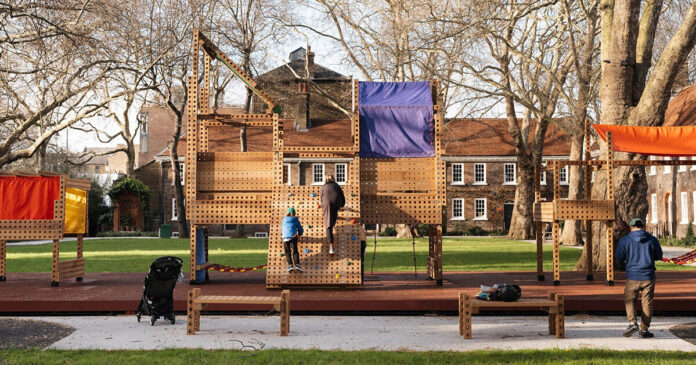
Playrise, developed by OMMX, Webb Yates Engineers, and SetWorks, was conceived for refugee settlements after field research in Ethiopia and Egypt. The project offers a modular system that communities can assemble, adapt, repair, and rebuild over time, responding to the realities of displacement, where permanence is rare and resources are limited, while acknowledging that children will continue to play, even when everything else around them has changed.
ART for The World’s Playgrounds & Toys arrives at a similar conclusion from the perspective of contemporary art. Since 2000, the initiative has invited artists, architects, and designers to develop playgrounds and educational toys that are inexpensive enough to be built in schools, public spaces, and refugee communities. The exhibition becomes only one stage of the project; what matters is that many of the ideas eventually leave the gallery and enter everyday life.
The point is not that a playground can undo the effects of war or displacement. It cannot. What these projects suggest instead is that recovery begins long before a community is rebuilt. Alongside shelter, healthcare, and education, children also need places to gather, invent games, make friends, and recover a sense of normality.
This is the principle that has guided organizations such as Right To Play and UNICEF for decades. Their programs treat play as part of children’s social and emotional recovery. Design, in turn, gives that principle a physical form. Whether through a temporary play structure, a schoolyard, or a community space, the question is no longer where children can play but what role play occupies within humanitarian response.

Assemble’s Brutalist Playground (read more here)
Beyond the Playground
The argument does not end at the playground or at the refugee camp. If play is recognized as part of recovery, then it also becomes a way of looking at the everyday city. Children read urban space differently from adults. A shortcut becomes a race. A low wall becomes a balance beam. A flight of steps becomes a stage for spontaneous performances. They are less interested in the purpose of a place than in what it allows them to do. The question for designers, then, is how much room a city leaves for the unexpected. That idea has begun to influence conversations around child-friendly urbanism as many architects and municipalities are asking how streets, schoolyards, parks, museums, and public spaces can support moments of play as part of everyday life. Sometimes the intervention is as simple as reducing traffic, widening pavements, or creating places to pause. Thinking this way changes how we judge public space. Cities are usually measured by density or connectivity, but those metrics reveal little about how they are experienced at ground level. A child’s perspective offers different criteria. Can they move around independently? Is there somewhere to linger? Is there enough freedom to invent a game that nobody planned? And those are questions ultimately not just about children. A city that makes room for wandering, meeting, resting, and play is often a city that works better for everyone.

Mavrovouni Playground by GDIRC, Lesbos, Greece
The Spaces We Protect
The projects explored here span different contexts, from post-war Amsterdam to refugee settlements and contemporary humanitarian programs. What connects them, though, is a shared understanding that play cannot be postponed until more urgent problems have been solved. It is part of how children understand the world around them, even in moments of disruption.
For architects, that distinction matters. Play cannot be designed in the way a building or a bridge can. It happens when children find enough freedom to invent their own uses for a place. The role of design is more modest, but no less important: to create environments that are safe, accessible, and open enough for those moments to happen.
Thinking about play this way also broadens the idea of infrastructure. Roads, schools, airports and hospitals are essential because they support everyday life. Spaces that allow children to explore, and imagine perform a different function, but one that is no less fundamental to healthy communities.
Article 31 of the UN Convention on the Rights of the Child recognizes play as a right. For architects, the question is what that right looks like once it enters the built environment. Not only in playgrounds, but in streets, schools, parks, museums, and public spaces. Children will always find ways to play. The real measure of a city is whether the environments we create still leave room for them to do so.

the Mavrovouni Playground uses modular timber play structures built in collaboration with refugees
