
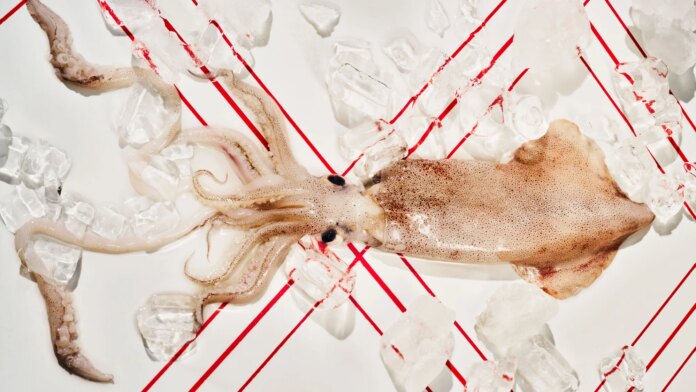
Ten-armed and otherworldly, squid loom large in literature and lore, often imagined as fin-soldiers of misfortune for cantankerous gods. Captains Nemo, Ahab, Sparrow, and Zissou were all haunted in some way by these avatars of the unknowable sea. One autumn midnight in Maine, while meditating on the eventide waters, I experienced my own haunting. In a moonlit column of the ocean was one such Kraken’s kin, an intelligent creature with powers of jet propulsion and camouflage, its spear-tip body hovering, its oversize eyes curious and menacing. As unsettling as they may seem, though, neither captain nor cook should harbor fear of these depth-dwellers; rather, we should feast upon them.
Squid’s tube-shaped bodies are sheathed with ink-tinted skin, with colors that shift to confuse predators and prey. When fresh from the water, this whisper-thin film radiates a nocturnal purple glow—a color I call “gloomshine.” For a creature so adept at variation in the water, it’s ironic that its presence on American plates is so singular. Rich Fuka, a Rhode Island fisherman who has had a storied career catching these creatures, says, “Squid is to Rhode Island as lobster is to Maine,” but that an overwhelming 75 percent of harvests are exported: “It’s the missing ingredient in the U.S.” And while squid are a globally fished and traded commodity, when responsibly caught with minimal bycatch, their quick reproduction cycles make them an especially sustainable seafood option.


Perhaps the most popular way to enjoy squid is deep-fried—“calamari” is a dish so ubiquitous that animal and preparation have become one and the same. But behind the breading is an ingredient of versatility and charm. Squid are entwined with most coastal cuisines and provide an important and voluminous food source across our oceans. Their diet of crustaceans and fish results in a creamy, crab-like flavor, which is emphasized in Sonoko Sakai’s recipe for ika somen, a Japanese sashimi dish where raw squid are sliced to mimic slippery noodles. The meat also has a porousness that easily absorbs a multitude of flavors: At Providence’s Dune Brothers Seafood, Nick Gillespie poaches squid in champagne vinegar and herbs before tossing the rings and tentacles with salami and giardiniera; at Seahorse in Charleston, James London tosses the grilled cephalopods with an herbaceous and spicy green harissa. Whether stuffed with a fragrant Cambodian lemongrass paste in a grilled recipe from chef Ros Rotanak, simmered with okra and coconut into a Zanzibari stew from chef Alexander Smalls, or braised in white wine for an inky black pasta at Sicilian restaurant Corona Trattoria, the recipes that follow feature a world of ways to interpret this humble sea creature. So let’s venture forth, leaving behind the safe harbor of fry oil and marinara sauce, to explore an entire realm of culinary adventure in which squid are the heroes, swimming from legend to lunch, terror to tender.
Squid are cephalopods, meaning “head on foot,” and in the kitchen, both tubes (head) and tentacles (foot) are cooked and eaten in the same way. (Technically, though, squid only have two tentacles; biologists refer to the other eight limbs as arms.) More than 300 species of squid swim in our oceans, some as small as a thumbnail, others enormous. Larger edible species, such as the Humboldt squid, would make rings the size of a basketball hoop, so they are cut into steaks instead. These steaks are then cut into strips or scored to tenderize the muscle and seared under weight to prevent curling, offering a meaty chew.
While many varieties are consumed worldwide, it’s best for U.S.-based cooks to purchase domestic squid certified by the Marine Stewardship Council (look for the blue label!). On the East Coast, shop for northern shortfin squid (Illex illecebrosus) and the slightly larger longfin inshore squid (Doryteuthis pealeii, sometimes called Loligo). On the West Coast, look for California market squid (Doryteuthis opalescens), a certified “Best Choice” by the Monterey Bay Aquarium Seafood Watch program. If you’re uncertain, ask your fishmonger or search seafoodwatch.org to find up-to-date recommendations.
“Dirty” is a term for squid pulled straight from the water, skin and organs still intact. Given their high perishability, they’re most frequently sold processed into skinless tubes and tentacles or further cut into bite-size rings for consumption. Fortunately, squid freezes well, and it’s in that aisle where you’ll most easily find it ready to be grilled or braised. If buying frozen, avoid products that list additives or water-retention agents (including sodium triphosphate, seaweed oligosaccharides, or salt), as these dilute flavor and impede the cook’s ability to achieve a high-heat sear or adhere breading. Thaw squid slowly in the fridge in a bowl of water, then rinse and pat dry with paper towels before cooking.
If you’re lucky enough to access “dirty” squid, look for those with the purplish skin largely intact and with an aroma that smells right, which is to say it gives no doubt of its freshness. To clean, separate the head from the body, pulling the attached organs with it. Cut the tentacles free just above the eyes, then squeeze out the hard beak from the center. Inside the tube is the quill, a firm cartilage feather that provides the animal’s skeletal structure. Remove this, then wash out the inside of the tube, pat dry, and cook as soon as possible.
Squid ink, from an internal reserve used to poof predators, is unique in culinaria. Its blackness is so profound as to seemingly erase color from all that it touches, but oh, what sexy glory of the seas it imparts! A small dab stirred into rice, pasta, or sauces packs an umami power punch. Ink sacs are delicate and, in small squid, can be quite tiny; you’re better off buying a high-quality jar of ink for cooking.
If you can’t get a whole squid with the ink sacs intact or if you’re feeling squeamish about prepping it yourself, reach for a jar of cuttlefish ink instead. Squid tend to spray most of their ink when caught, but cuttlefish are more patient, leaving some behind for cooks to work with. Flavor-wise, cuttlefish ink is richer, earthier, and rounder, while squid ink can taste sharper, saltier, and even a little metallic—though usually a small enough amount is used that you wouldn’t notice a difference. The ink brings glossy black color and deep umami to any dish, all without the inky drama that comes with fresh squid. It’s easy to find at specialty markets or online.


