
RECLAIMING SEOUL’S DORMANT WATERFRONT
Snøhetta’s Banpo Ecological Playscape imagines the edge of Seoul’s Hangang River as a layered public landscape where wetlands, cultural spaces and elevated pathways overlap. Developed for the international Banpo–Hangang River Connection Park and Cultural Facilities competition in 2024, the proposal reached the final round but was not selected for construction. Its architectural afterlife therefore exists on paper, where roads are slightly easier to move and urban wounds rather more willing to heal.
Spanning 38,000 square meters beside the Hangang riverside park and above the Olympic-daero expressway, the design sought to reconnect the Banpo neighborhood with a waterfront fragmented by decades of urban development. Snøhetta envisioned the site as both ecological infrastructure and civic destination, restoring public access to the river while creating habitats capable of responding to floods, seasonal changes and the less poetic consequences of metropolitan growth.

Snøhetta’s ecological playscape reimagines seoul’s hangang waterfront | all images courtesy of Snøhetta
AN ECOSYSTEM THAT DOUBLES AS A PLAYGROUND
The proposal is organized around two interconnected layers: the ‘ecosystem’ and the ‘playscape.’ At ground level, reconstructed wetlands, waterways and woodlands would form a self-regulating landscape designed to filter water and support biodiversity. By directing part of the surrounding catchment into a proposed wetland channel, the scheme also explored how public space could reduce pressure on Gangnam’s existing drainage network rather than simply looking picturesque beside it.
Above this ecological base, the playscape brings together plazas, gardens, educational areas, play zones, an amphitheater and indoor cultural facilities. Snøhetta describes play expansively, imagining a landscape shared by children, adults, animals, insects, wildlife and even robots. It is a generous guest list, although the insects were presumably never consulted.

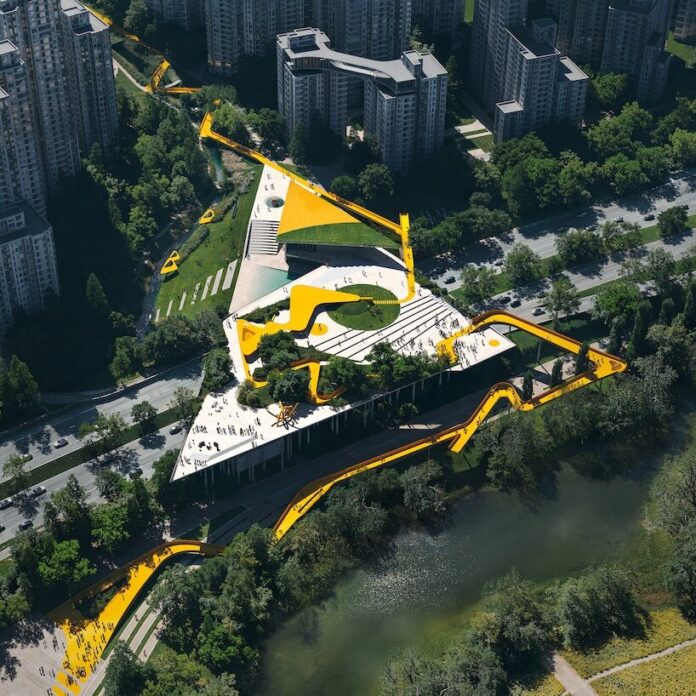
elevated pathways reconnect the banpo neighborhood with the river
A TRIANGULAR LANDMARK ABOVE THE EXPRESSWAY
Three elements shape the proposal: a natural landform, a triangular platform and a connective thread. The platform folds over the landscape and expressway to produce sheltered interiors, elevated viewpoints and event spaces while helping buffer traffic noise below. Exhibition rooms, a library and cafés are integrated into its sculptural structure, allowing enclosed programs to spill onto terraces overlooking the Hangang River.
A continuous pathway then ties the ecological zones, cultural facilities, surrounding neighborhoods and waterfront together. Although the Banpo Ecological Playscape will not be built, the proposal offers a clear argument for treating infrastructure, flood management and recreation as parts of the same urban system. In place of a conventional park placed beside a road, Snøhetta imagined a landscape capable of crossing it, absorbing water around it and making the river feel less like scenery viewed from the other side.

wetlands, woodlands and public programs form the project’s ecological framework

the unbuilt proposal spans 38,000 square meters beside the hangang riverside park
