
world heritage list 2026
The final decisions from UNESCO‘s World Heritage Committee bring together a broad and sometimes unexpected view of heritage. A modernist sanatorium in Finland now shares the list with a porcelain-making landscape in China. Coral reefs in Jordan sit beside a South Sudanese migration route crossed by millions of animals, while cliffside towns and fortified mountain networks reveal how people have shaped difficult terrain over centuries.
UNESCO announced 25 inscriptions at the close of the World Heritage Committee’s 48th session on July 28th, 2026. The final count includes 19 cultural properties and five natural ones. Mount Olympus is the sole mixed cultural and natural addition. Comoros and São Tomé and Príncipe received their first World Heritage properties. South Sudan joined the list for the first time as well, bringing the global total to 1,273 sites across 173 countries.
Several entries speak directly to architecture and design, from Alvar Aalto’s collaborative practice to the late Soviet buildings that reshaped Tashkent after the 1966 earthquake. Others ask readers to consider design through production and belief, or through ecological adaptation and political control. Taken together, the 2026 class reads as a map of structures and systems, with the built environment extending far beyond the individual building.
aalto works, finland
Thirteen buildings and ensembles completed between 1928 and 1988 form the Aalto Works inscription. The group includes civic and residential projects across Finland, bringing together designs associated with Alvar Aalto and the contributions of Aino Marsio-Aalto, Elissa Aalto, the wider studio, and its collaborators. Paimio Sanatorium and Villa Mairea sit within the collection alongside Säynätsalo Town Hall and several Helsinki buildings, tracing an approach that treated architecture, interiors, furniture, and landscape as connected parts of the same experience.

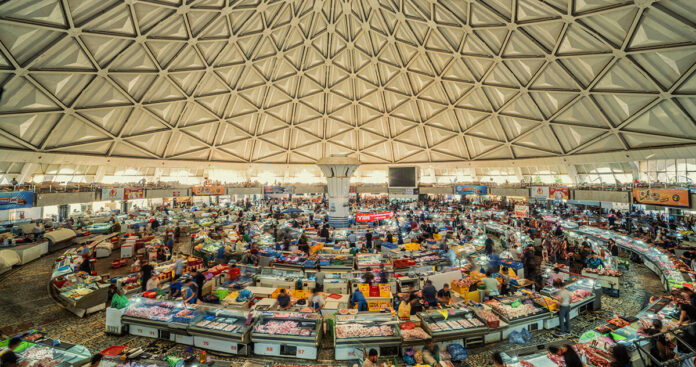
Finlandia Hall, 1967-75, Helsinki | image by Rune Snellman © Alvar Aalto Foundation (header: Chorsu Market, Uzbekistan | image © Karel Balas)
tashkent modernist architecture, uzbekistan
Ten buildings and urban complexes trace Tashkent’s reconstruction after the 1966 earthquake. Built from the 1960s through the early 1990s, the group includes cultural institutions and housing along the planned axes of the rebuilt center. Industrialized construction and seismic engineering meet regional materials, while ornamental traditions and responses to the local climate give late Soviet modernism a specific Central Asian expression.

Central Exhibition Hall of the Academy of Arts, Uzbekistan | image © Karel Balas, courtesy ACDF
gdynia modernist city centre, poland
Gdynia’s interwar center grew as Poland transformed a Baltic fishing settlement into a major national port. Planning blocks organize the principal streets, with housing placed alongside civic architecture. Villas rise separately on Kamienna Góra hill. The district records a rapid break from historicism, using modern architecture to give a newly expanded city its public image.

Market Hall Complex, 38 Wójta Radtkego Street, Poland | image by B. Ponikiewski © Gdynia City Hall
jingdezhen handicraft porcelain industry sites, china
Five component sites trace porcelain production in Jingdezhen from the 10th through the 19th century. Clay extraction and transport connect to workshops, kilns, guilds, and merchant networks across an immense industrial landscape. The inscription brings attention to the organization behind the finished object, including kiln innovation and the kaolin-based formula that supported the city’s globally traded blue-and-white wares.

Huanglaodayao Kiln Remains | image by Chen Kai © Jingdezhen Handicraft Porcelain Industry Heritage Conservation Center
italian-style condominio theatres, italy
Ten theaters across central Italy preserve an unusual model of collective ownership. Municipalities and private citizens financed the buildings together, producing a network of performance spaces in smaller urban centers from the mid-18th through the late 19th century. Tiered boxes wrap around neoclassical auditoriums, making the social structure of the audience visible within the architecture.

Teatro Nuovo Gian Carlo Menotti, Spoleto, Italy | image by Giuseppe Nardi © Fondazione Marche Cultura
amazonia theaters, brazil
This serial property pairs Theatro da Paz and Praça da República in Belém with Teatro Amazonas and Largo de São Sebastião in Manaus. Built during the rubber boom between 1879 and 1912, the ensembles borrowed from European theater architecture while drawing decorative imagery from the Amazon. Their opulent interiors and public squares reveal how performance buildings helped two remote trading cities project political confidence and metropolitan ambition.
