
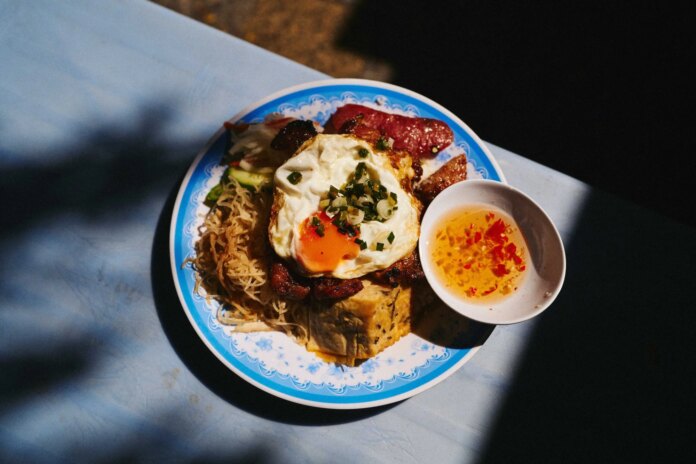


Ho Chi Minh City, commonly still known as Saigon, is a breakfast-lover’s paradise where mornings can begin with anything from steaming bowls of noodle soup and crisp bánh mì to sizzling Vietnamese steak and eggs, or bò né. But to understand the city’s culinary identity, follow the unmistakable smell of pork fat hitting hot charcoal to find yourself a plate of cơm tấm.
The dish begins with tấm, the shattered grains left behind during rice harvesting and milling. During the late-19th and early-20th centuries, under French colonial rule, whole grains were exported or sold at higher prices, while broken rice remained an inexpensive staple for working-class families. Over time, that necessity evolved into tradition. Today, the once overlooked broken rice—sometimes cooked with pandan leaves for flavor—is prized for its soft texture and ability to soak up fish sauce, scallion oil, and savory juices from grilled meat.
“Cơm tấm comes from the hard times in Vietnam,” explains Lê Việt Hồng, the Saigon-born chef and co-owner of Michelin-starred CieL Dining. “The broken rice is the most important part. You could eat the rice alone with just fish sauce and it would already be delicious. But all the toppings are what makes it perfect.”
Indeed, what elevates modern cơm tấm is everything that’s piled on top. As the dish spread from the Mekong Delta to Saigon, the simple meal evolved into the abundant plate often listed as cơm tấm sườn bì chả. Sườn is the signature charcoal-grilled pork chop; bì is a mixture of shredded pork skin tossed in toasted rice powder; and chả is a steamed egg-and-pork loaf studded with glass noodles and wood ear mushrooms. Many shops add trứng ốp la, a sunny-side-up egg, along with Chinese sausage, crisp pork fat, or whatever specialty the house is known for.


The dish is finished with mỡ hành, or scallion oil; sliced fresh cucumber and tomato wheels; tart pickled carrot and daikon; and a small bowl of seasoned nuoc mam, or fish sauce, to pour over everything. As in nearly every Vietnamese dish, that sauce is not a peripheral condiment but rather the plate’s binding force, layering it with salt, sweetness, acidity, and heat.
For Hồng, the beauty of cơm tấm lies in its balance. “The barbecue is very sweet. When you try it with the pickles, everything is balanced. It’s like yin and yang,” he says. His favorite topping is the sunny-side-up egg because “the runny egg yolk makes the rice more creamy.” As for fish sauce? “Without fish sauce, maybe it’s not Vietnamese anymore.”
Every cơm tấm shop begins with the same familiar formula, but each has its own point of view. Some are steadfast purists, serving the classic plate much as they have for decades, while others reinterpret the dish with premium ingredients, contemporary techniques, and unexpected additions. From a Michelin Bib Gourmand-recognized mainstay near the airport to a TikTok sensation far from the city center in District 8, these are seven cơm tấm destinations worth seeking out across Saigon.
The chef’s pick: Cơm Tấm 43 Dũng


Cơm Tấm 43 Dũng has been serving its namesake dish in the burgeoning Bình Thạnh neighborhood for more than 30 years—though even the current owners, who are all part of the same family, can’t quite remember the exact year it opened. Named after its owner, Dũng (pronounced zoo-ng), the longtime neighborhood favorite is best known for its straightforward version of charcoal-grilled pork, fragrant broken rice, and sweet-savory fish sauce, drawing generations of regulars, including Hồng, who has been eating here since he was six years old.
The historic standard: Cơm Tấm Nguyễn Văn Cừ


Open since 1989 in the historic Cầu Ông Lãnh ward, Cơm Tấm Nguyễn Văn Cừ has become one of the city’s best-known—and most polarizing—cơm tấm institutions. Starting at 75,000 VND (roughly $2.85), the prices are noticeably higher than your average neighborhood shop, but so are the portions, particularly its signature charcoal-grilled pork chop, which is famously oversized and thick enough to spill over the edges of the plate. Whether you consider it worth the premium or not, the lunchtime crowds suggest plenty of diners do.
The Michelin selection: Cơm Tấm Ba Ghiền


Cơm Tấm Ba Ghiền has become one of Saigon’s most recognizable cơm tấm destinations since it opened in1995—and the only one to earn a Bib Gourmand from the Michelin Guide. Like Cơm Tấm Nguyễn Văn Cừ, its calling card is an enormous charcoal-grilled pork chop marinated in a closely guarded family recipe and served with the classic accompaniments, including a standout take on chả trứng, or steamed egg meatloaf. It’s for you to decide whether it’s the city’s best or simply its most famous.
The TikTok sensation: Cơm Tấm Ba Há


If you’re staying in the city center, the journey to Cơm Tấm Ba Há feels like a pilgrimage into District 8—a historically working-class, canal-laced neighborhood. Here, the eponymous Mrs. Ba Há has been serving cơm tấm for more than 50 years, long before there was a storefront or sign. Over the decades, she’s expanded the menu with unusual housemade specialties like chả cá, plus her now-famous chả trứng muối—an oversized steamed pork meatball studded with wood ear mushrooms and wrapped around a whole salted egg yolk. Those signature additions have helped the humble neighborhood institution find a new generation of fans through TikTok. Open only from 4 p.m. to 6:40 p.m., the family-run institution routinely sells out before closing.
The late-night craving: Cơm Tấm Đêm Cubo


While cơm tấm is conventionally eaten in the morning, this viral spot makes a compelling case for a midnight breakfast. This cơm tấm đêm—with đêm meaning “night” in Vietnamese—is served until 12:30 a.m., drawing everyone from hungry hospitality workers to revelers looking for something to soak up the booze. The restaurant is known for its broken rice (which some online reviews claim is softer and fluffier than the usual) and thick-cut charcoal-grilled pork chops. Go for the usual toppings, but also request a bowl of pork lardons (tóp mỡ) to scatter over the top for extra richness and crunch.
The modern classic: A Xỉu


At just 28, Nguyễn Thanh Tú built a loyal following through a mobile cơm tấm pop-up before opening his permanent restaurant in District 1. Here, one subtle but deliberate decision sets his version apart: Instead of serving fish sauce on the side, every plate arrives already dressed, with a viscous, sweet-savory nuoc mam glaze poured over the broken rice in the exact proportion he intends. It’s a distinguishing chef’s touch that transforms a customizable street food into a personal statement. Oddball garnishes like housemade kimchi (in lieu of pickled daikon) and rotating sides (such as a standout purple yam soup) round out the experience. It’s important to note that while there’s air-conditioning and an art-filled dining room, A Xỉu sacrifices none of the warmth, or irreverence, of a neighborhood cơm tấm hawker.
The (American) barbecue remix: Roast & Smoke Thao Dien


Tucked inside a quiet alley in the expat hub of Thảo Điền in District 2, Roast & Smoke Thao Dien is an all-day roastery, café, pizzeria, sandwich shop, and barbecue smokehouse built around an eclectic menu of fire-cooked food. Its special cơm tấm, served until 3 p.m., applies that same low-and-slow philosophy to Saigon’s signature rice plate, replacing the traditional charcoal-grilled pork chop with a choice of ribs or pork jowl—pit-smoked over fragrant tropical longan wood rather than American oak. Served alongside broken rice, chả trứng, pickles, scallion oil, and sweet-savory nuoc cham, it’s a thoughtful East-meets-West barbecue riff that still feels unmistakably at home in Vietnam.
