
FINNISH PLAY CULTURE MEETS THE BARBICAN
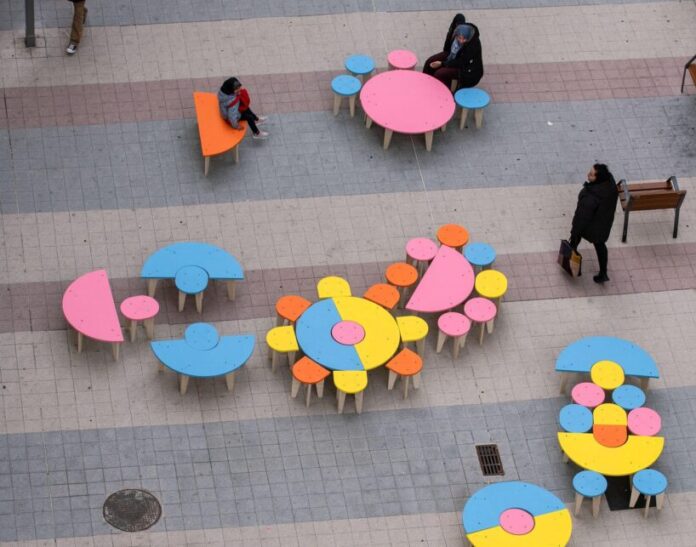
Päivi Raivio is bringing Basic Forms (of Urban Life) to the Barbican Centre in London as part of the Play Make Do festival, taking place from August 14 to 16, 2026. Presented by the Finnish Institute in the UK and Ireland, the participatory installation combines art, urban design and play through a collection of simple geometric plywood elements that visitors are invited to move, group and rearrange. The result is not so much a finished composition as an urban kit of parts waiting for someone to interfere with it.
The colors of the installation are drawn from details found across the Barbican’s architecture and surrounding environment, allowing the pieces to echo their setting without attempting to compete with several acres of concrete. As visitors alter their arrangement, the objects continuously generate new forms, meeting points and temporary uses, transforming a public passage into a space for experimentation, leisure and encounters between strangers.

Päivi Raivio’s geometric plywood pieces can be moved and combined | images by Jose Cutillas and Sara Cuerdo
PUBLIC SPACE BECOMES A SHARED CONSTRUCTION
For Raivio, play operates as more than an activity added to the city after the serious work is done. It becomes a design principle capable of introducing surprise, freedom and less prescribed ways of interacting with other people. By leaving the installation deliberately open-ended, Basic Forms (of Urban Life) raises questions around who public spaces belong to, whose behavior they accommodate and who is permitted to participate in shaping them.
The project draws on Nordic child-oriented design and traditions of free play, while advancing what Raivio describes as design democracy in public space. Rather than assigning the objects a single correct function, the work allows visitors of different ages to decide how they should be used. A seat might become a table, a platform or part of a larger improvised structure, depending on who arrives next and how seriously they take the instructions — which, fortunately, are minimal.

the images document Basic Forms (of Urban Life) during its presentation at Concéntrico in Logroño, Spain
COLORFUL GEOMETRIES INTERRUPT BRUTALIST CONCRETE
Designed from the 1950s and completed in 1982, the Barbican complex provides a suitably monumental backdrop for Raivio’s lightweight, colorful forms. The contrast between fixed Brutalist architecture and an installation that can be continually remade establishes a dialogue between permanence and participation. According to the designer, the project seeks to make room in the built environment for curiosity, spontaneity and activity without a supposedly greater purpose, while giving children a more visible place within urban life.
Basic Forms (of Urban Life) was previously presented at the Concéntrico architecture and design festival in Logroño, Spain, and has been conceived to adapt to different sites. Each iteration changes according to its location, surrounding architecture and the people who activate it. Following the Play Make Do festival, the installation will become part of the Barbican’s collection, preserving a project whose most important feature is its refusal to remain in one configuration for very long.

brightly colored circles and semicircles transform the paved public space into an open-ended playground

the installation invites visitors to decide how its tables, seats and platforms should be used

each configuration emerges through play, participation and encounters between people in the city
