
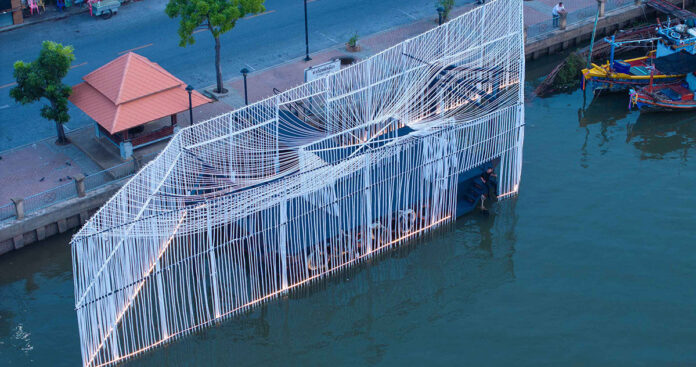
a waterfront shaped by fishing and faith
Along the Pattani River in southern Thailand, HAS design and research has built a bamboo pier around the routines of the city’s fishing communities and the ecology that supports them. Pattani sits close to the Malaysian border, where Muslim heritage and Malay-Thai histories have shaped a distinct regional identity. The river has long been central to that identity, supplying livelihoods while linking the city to the sea. The new Pattani Fishermen Community Hub places that relationship back at the center of the waterfront.
The commission grew from a wider question about how fishing infrastructure could serve the city beyond boat access. Architects Jenchieh Hung and Kulthida Songkittipakdee studied the local industry alongside the river’s ecological conditions, then developed a structure where working space and public access could occupy the same site. Fishing boats can pull alongside the platform, while families gain room to gather near the water.

images © Rungkit Charoenwat
architecture above and below the waterline
Raised on a steel platform, the Pattani Fishermen Community Hub allows currents and sediment to move beneath it while boats dock at the edge. Locally-sourced bamboo forms the primary structure, which brings a familiar renewable material into direct contact with the river. The architects at HAS treated its hollow sections as small habitats, using durable protective coatings while leaving surfaces where algae and aquatic organisms can establish themselves.
Large openings cut through the platform and keep broad areas of water visible inside the structure. Submerged stones add shelter below, while bamboo elements create another layer around the waterline. Together, these features are designed to support fish and shellfish populations alongside the pier’s human use. The architecture touches the river lightly, with much of its activity taking place through openings and shaded edges above the current.

the Pattani Fishermen Community Hub stands along the Pattani River in southern Thailand
a pier that changes through the day
From early morning onward, the hub operates as part of Pattani’s fishing economy and gives crews space to head out and unload their catch when they return. As work eases later in the day, the same platform opens to swimmers and children watching life below the surface. The shift feels direct because the project avoids separating labor from recreation. Both happen at the river’s edge, within view of the boats and the water that sustains them.
As daylight fades, the waterfront draws runners and visitors who use the platform for views across the river. The hub also hosts religious gatherings and community ceremonies. It serves as a starting point for Pattani’s annual long-boat racing festival. These uses turn a piece of infrastructure into a civic room without stripping away its original function. The pier keeps working while the city moves through it in other ways.

HAS design and research raises the steel platform above river currents and sediment flow
built with the sabarang community
Set within Pattani’s broader civic geography, the project follows the historic direction of the river and aligns with the City Pillar Shrine, while another axis extends toward Pattani Mosque. Those relationships place the hub within a landscape shaped by trade and faith, with fishing activity running through both. The building stays open and porous, allowing those layers to meet at the water instead of being compressed into a single symbolic gesture.
The Sabarang community joined the architects in constructing the project, giving the final structure a close connection to local knowledge and use. Across its 148 square meters, the hub provides a working pier alongside an outdoor classroom. It also gives residents a place to spend time beside the river. Its strongest idea sits at the waterline as architecture can make room for public use while giving aquatic species space to return beneath it.

locally-sourced bamboo forms habitat along the water’s edge

hollow bamboo surfaces support algae and small aquatic organisms
