
COMFORT IS NOT THE POINT
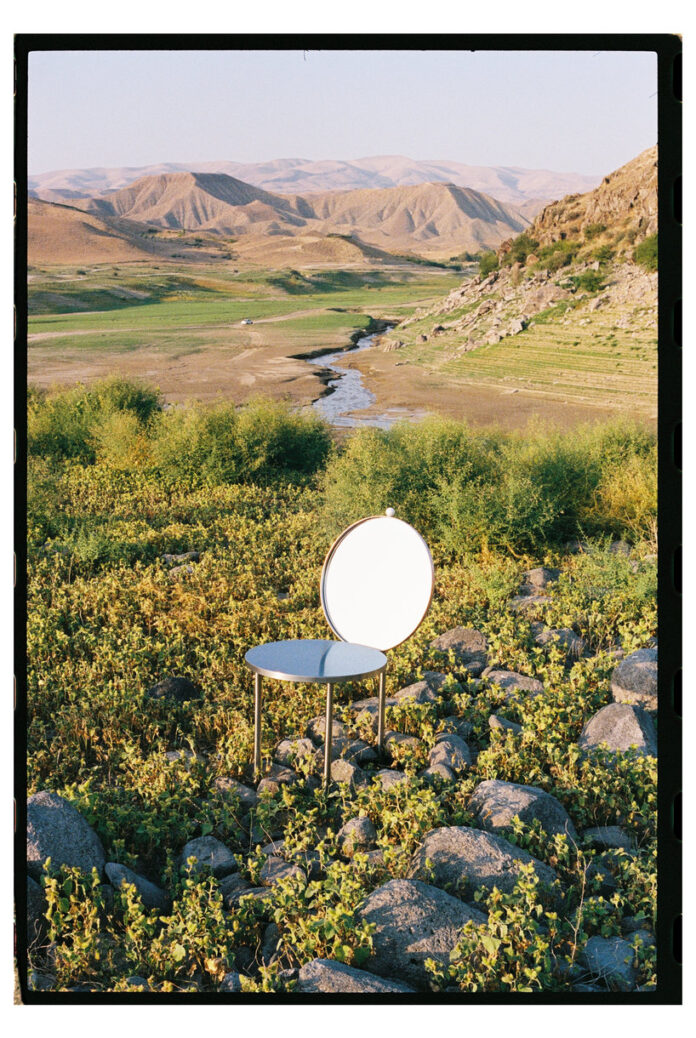
Armenian designer Shushana Khachatrian, founder and design director of STUDIO SHOO, deliberately removes comfort from an object normally defined by it with The Woman’s Chair. Conceived as a reflection on the relationship between women and contemporary social structures, the piece uses posture, instability and restricted movement to explore ideas of cultural expectation, visibility and control. At first glance, its polished stainless-steel body appears precise and minimal; sitting down reveals a rather less accommodating agenda.
The chair rests on three stainless-steel legs, introducing a subtle instability, while its angled backrest prevents the sitter from reclining comfortably. Instead, the body is held in an upright position that Khachatrian uses as a metaphor for expectations around composure and restraint. ‘The piece is about boundaries — how women are often expected to hold themselves in a certain way, to occupy space with restraint,’ the designer explains. Here, discomfort is not an unfortunate ergonomic oversight but the project’s central design device.

all images courtesy of STUDIO SHOO
A MIRROR THAT WILL NOT SIT STILL
Integrated into the backrest is a mirror that complicates the relationship between sitter and object further. Rather than returning a stable portrait, the reflective surface offers a partial image that shifts or disappears as the body moves. Khachatrian connects this fleeting reflection to changing perceptions of identity and visibility, examining how the image of oneself can become dependent on position, perspective and external expectations.
Material contrasts reinforce the idea. The chair’s hard, reflective stainless steel is paired with an optional satin cushion edged with delicate frills, introducing softness and ornament into an otherwise severe structure. Handmade by Armenian fashion designer Hrachuhi Martirosyan, the textile element establishes an intentional tension between strength and vulnerability, rigidity and decoration — though the addition of satin does not suddenly turn the chair into somewhere to spend a lazy afternoon.

polished stainless steel shapes the deliberately uncomfortable seat
SITTING BECOMES SOCIAL COMMENTARY
The stainless-steel structure was produced by Armenian furniture manufacturer Canate, translating Khachatrian’s unconventional geometry into a functioning object. Chosen for its durability, strength and corrosion resistance, the material also gives the chair an uncompromising visual character: reflective enough to implicate its surroundings, but physically hard enough to keep the sitter constantly aware of the object beneath them.
Operating somewhere between furniture and sculpture, The Woman’s Chair uses the familiar typology of seating to ask less familiar questions about who is permitted to feel comfortable, how bodies are expected to behave and how much space they are encouraged to occupy. Rather than illustrating those pressures directly, Khachatrian embeds them into the mechanics of the chair itself. It can be sat on, technically. Whether it wants you to relax is another matter entirely.

reflective surfaces shift with the sitter’s movement

three legs introduce a subtle sense of instability
