
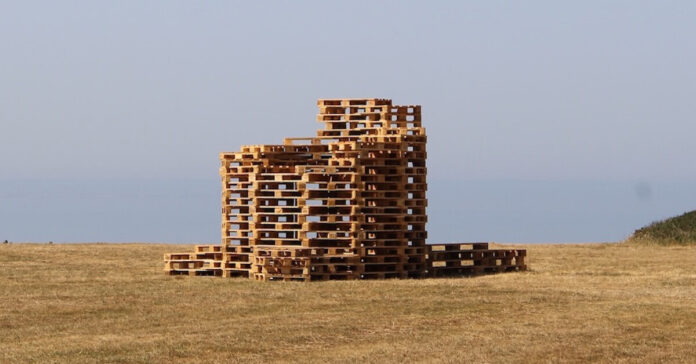
Stacked timber pallets create a shelter by Jakob+MacFarlane
Designed by Jakob+MacFarlane, A Shelter for Peace is a temporary installation located on the exposed headland of Cap Carteret in Normandy, France, overlooking the English Channel. Commissioned by Nadine Gandy of Gandy Gallery as part of the Common Shelters initiative, the project explores the concept of shelter through the reuse of reclaimed wooden pallets, examining the relationship between architecture, landscape, and contemplation.
Responding to the site’s exposed coastal conditions, the design reinterprets the shelter as both a place of protection and a framework for engaging with the surrounding environment. Constructed from stacked reclaimed pallets, the installation develops a layered architectural system in which the timber elements form walls that also function as integrated seating. The arrangement frames views toward the offshore islands while creating an enclosed space oriented toward the sky, establishing different relationships between the interior, the landscape, and the horizon.

all images © Jakob+MacFarlane
Reversible construction reinforces the shelter’s temporality
Positioned between architecture, landscape installation, and public space, A Shelter for Peace functions as both a physical refuge and a place for quiet observation. Its simple material palette and reversible construction emphasize reuse while demonstrating how reclaimed construction materials can be adapted into a spatial structure with minimal intervention.
The installation, developed by architects Jakob+MacFarlane, forms part of Common Shelters, an annual program at Cap Carteret through which Gandy Gallery invites a European designer or architect to create a contemporary interpretation of shelter. The initiative investigates shelter as a space for refuge, social interaction, and contemplation through ecological, cultural, and landscape-based approaches. A Shelter for Peace will remain on site until the end of September 2026.

reclaimed wooden pallets define the structure

the installation responds to the exposed coastline
