
OPPOSITE OFFICE TAKES DOWNSIZING TO THE TREETOPS
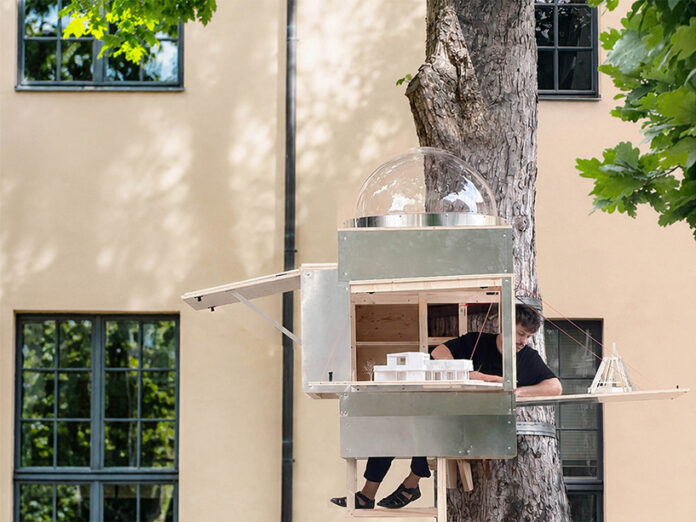
Munich-based architecture practice Opposite Office has opened its latest workplace inside a tree on the historic campus of Bauhaus-Universität Weimar. Named Baumhaus Office, the approximately one-square-meter structure responds to a fairly terrestrial problem: Munich’s high office rents. Since much of the studio’s work already takes place across changing international locations, the architects began questioning whether an internationally operating practice needed a large permanent headquarters at all.
The answer is a tiny elevated workspace designed for two to three architects, temporarily installed in one of the campus trees while Opposite Office works on two projects in Weimar: Fictional Infrastructures at M Books Gallery and Last Fellow II at ACC Galerie, the latter developed in cooperation with Villa Massimo Rome. The tree itself is among the oldest in Weimar and, according to the studio, was reportedly planted by Johann Wolfgang von Goethe during his time in the city. A desk, workstations, model-making area and essential infrastructure are compressed into the smallest possible footprint, turning spatial economy into both necessity and architectural proposition.

all images courtesy of Opposite Office
FROM BAUHAUS FUNCTION TO ROMANTIC CONTEMPLATION
The temporary office also places itself within Weimar’s long tradition of experimental construction. On a campus historically associated with rationality, function and modern ideas of progress, Opposite Office introduces another reference point: Romanticism and its understanding of nature as something more than background, resource or object of study. Here, the tree is not simply supporting the architecture; it becomes one of its central occupants.
A skylight reinforces that shift in perspective. Rather than opening toward an abstract patch of sky, it looks directly into the tree canopy above, bringing branches and leaves into the architects’ immediate field of vision. The gesture turns the small building into an instrument for observation, briefly directing attention away from the built environment and toward something considerably older — and rather less interested in deadlines.

the one-square-meter workspace sits among the trees
HOW LITTLE OFFICE DOES AN ARCHITECTURE PRACTICE NEED?
Opposite Office draws a parallel with Cosimo, the protagonist of Italo Calvino’s The Baron in the Trees, who leaves life on the ground to inhabit the treetops. Baumhaus Office adopts the reference not as a proposal for escape but as a way of changing vantage point. Its extreme reduction of conventional office infrastructure reflects the studio’s broader working model, in which architects move between different cities, institutions and contexts rather than organizing every project from one fixed headquarters.
The treehouse consequently functions as workplace, meeting point and starting point for new projects while remaining intentionally open to visitors, clients and students. Opposite Office also describes more-than-human inhabitants as welcome, extending the idea of occupation beyond the architecture practice itself. With little more than a desk, a roof and a tree beneath it, Baumhaus Office asks how much architecture architects actually require to work — and suggests that the answer may be substantially less than the average office lease implies.

the compact office accommodates two to three architects

the temporary structure occupies the Bauhaus campus in Weimar
