
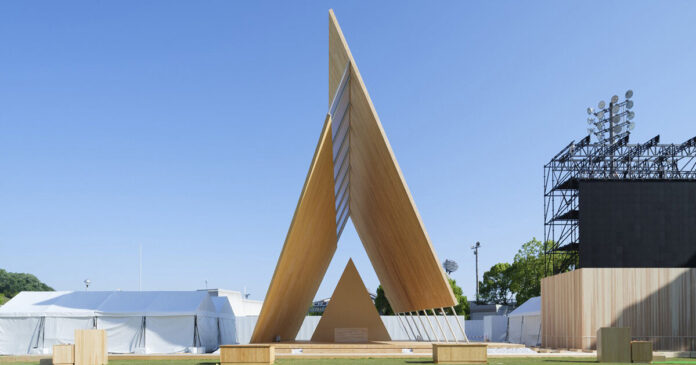
Three Rotating Planes Define Onodatesho Pavilion’s Form
Crafted from regional cedar and cypress, the Onodatesho Pavilion was designed as the ceremonial structure for Japan’s annual National Tree-Planting Festival, hosting the Emperor and Empress during the day-long event dedicated to forest appreciation and preservation. Since 1950, Japan has commissioned a temporary piece of state architecture for the festival, with the ceremonial pavilion traditionally dismantled shortly after the event.
For the pavilion in Ehime, Yano Aoyama Architecture Design developed a timber structure that combines large-scale cross-laminated timber (CLT) panels with a simple structural system and an approach centered on reuse. The largest CLT panels transportable in Japan, measuring 12 by 2.3 meters, are kept substantially intact. Instead of relying on extensive cutting to define the overall form, the geometry is produced through six operations: tilt, rotate, lean, taper, shift, and cut. These operations are coordinated through a single joint detail repeated throughout the structure.
The pavilion comprises three principal asymmetrical planes that rotate around an imaginary axis. One of the main wooden masses leans ten degrees toward the audience, referencing the profile of nearby Mt. Ishizuchi and supported by slender steel rods. The planes are positioned according to ceremonial sightlines and requirements for sun protection, while their arrangement reflects the festival’s theme of renewal: plant, grow, use, repeat.

festival grounds bird’s eye view | all images ©Yano Aoyama Architecture Design
Timber Reuse Extends the Pavilion Beyond Its Temporary Life
The structure was developed in collaboration with local carpenters, CLT manufacturers, and drafters, combining regional timber traditions with contemporary timber production. Cedar and cypress sourced from Ehime establish a direct material connection with the region’s forests, while the use of large CLT panels reflects developments in local timber technology.
Material reuse extends throughout the temporary construction by Yano Aoyama Architecture Design Studio. Cut-offs from the primary CLT panels are incorporated into secondary elements, including the stage stairs. Following the festival, the main panels can be unbolted and repurposed within the regional school network as custom furniture. The pavilion’s temporary lifecycle therefore forms part of its architectural strategy, with its timber components designed for subsequent use after dismantling.

distant view from the audience area

overall composition of the CLT boards

detail of anchoring plate

Onodatesho bird’s eye view

interplay of the three main planes (CLT boards)
