Serweta Peck Turns Historic Canal Building into Flexible Art Hub
The Medina Triennial Hub by Serweta Peck is an adaptive reuse interior renovation of a landmark building into the headquarters of an inaugural art triennial. Sited along the Erie Canal in the Village of Medina, halfway between the cities of Buffalo and Rochester in New York State, the Hub is part of a larger arts initiative to revitalize rust-belt cities along the canal as a joint commission by the Medina Triennial 2026, New York Power Authority (NYPA), and the Canal Corporation. For the duration of the triennial, the Hub serves as the Triennial’s ‘living room’ for community gatherings, artist workshops, talks and screenings, as well as provides an anchor point for visitors, staff and artists-in-residence.
Serweta Peck partnered with SUNY Buffalo architecture students to design and build out all the furniture with locally found and reused materials in response to the triennial’s theme of maintenance and sustainability. Through hands-on research, collaborative discussions, experimentation, prototyping, and fabrication, the project team created a family of flexible pieces (dubbed ‘Objects Of Affection’) that can adapt to a wide variety of activities and programming. Taking inspiration from humble, everyday materials as well as Enzo Mari’s Autoprogettazione, which dealt with the DIY construction of furniture from ubiquitous materials, the team employed unconventional and sustainable materials and processes as a means to challenge the typical biennial/triennial norms of design/build/trash.

view from the Medina Triennial Hub entry during its grand opening | all images ©Douglas Levere
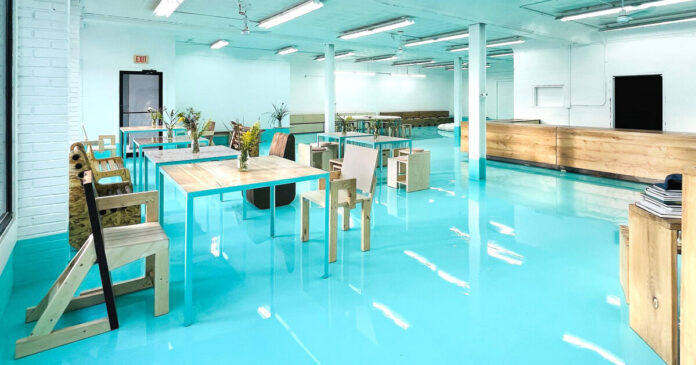
reused Materials and Teal elements connect the Hub to the Canal
The resulting objects include materials made from recycled wine corks cast in hydrocal, polystyrene insulation foam salvaged from students’ architecture study model scraps, wood chip waste cast in bio-resin, empty plotter paper tubes, laminated recycled cardboard, offcut lumber, a second-hand solid core door, an upcycled terracotta facade panel, and discarded Umbra Oh chair legs rescued from the dumpster. Most notably, NYPA donated seven 200-year-old pieces of scrap oak lumber, each measuring 17 feet long and weighing 850 pounds, that were previously submerged as part of the construction of the Erie Canal lock system.
All the salvaged lumber was processed for use by the project team at the university’s fabrication facilities. The wood’s natural knots, cracks, and imperfections were celebrated as details and minimally repaired in the spirit of kintsugi using bio-resin and sawdust. The interior architecture was stripped down to its fundamental components, exposing the previously boarded-up steel structure and masonry while preserving the original tin ceiling. The new color palette of the Hub’s floor, walls, and columns was inspired by historic postcards of the Erie Canal and was painted with a teal-colored epoxy ‘water line’ to evoke the rising and falling waters of the nearby canal via its lock system, providing a unifying ground to tie together the diverse furniture objects.

sunset illuminating the back of the Hub, reflective in the teal epoxy floor
Opened in September 2025 for community engagement, the Hub is set to be fully activated from June to September 2026 as part of the Medina Triennial, which brings together artists and collectives from around the world to create site-responsive works of art and participatory public programs. After the triennial, the objects will be auctioned, sold, donated, rehomed elsewhere, and find reuse afterwards, or can be responsibly and respectfully disassembled and recycled.

‘Modulation Stools’, ‘Side Hustle Stools’, ‘Pocket Stools’, and ‘Nesting Tables’ set the Gathering Space
