Cold War bunker becomes vessel for memory and displacement
Checksy Choi’s Eotieum: The Ply of Longing transforms a Cold War bunker into a site-specific installation that examines memory, displacement, and unresolved connection through steel, hanji, and participatory spatial interventions.
Presented inside a former Cold War anti-tank bunker in Seoul, the exhibition occupies the site’s two chambers and connecting corridor, using the existing architecture as a framework for a sequence of installations. The project takes as its point of departure the fishing boat that the artist’s grandmother boarded while fleeing North Korea during the Korean War. Rather than reconstructing the vessel, Checksy Choi translates it into Eotieum (엇이음), a conceptual framework that understands misalignment not as the failure of connection, but as the condition through which relationships continue to exist. Developed shortly after the passing of the artist’s grandmother, who had intended to see the completed exhibition, the project draws on personal family history while addressing broader questions of division, migration, and remembrance.
The choice of the bunker is integral to the project. Originally constructed to withstand military impact, the concrete structure provides an architectural environment defined by enclosure, distance, and endurance. Instead of treating the site as a symbolic backdrop, the exhibition works directly with its physical characteristics, allowing the existing architecture to shape the spatial experience and material relationships throughout the installation.

installation view of Eotieum: The Ply of Longing, Peace Culture Bunker, Seoul, 2026 | all images ©Checksy Choi
Checksy Choi’s Eotieum layers steel, hanji, and human movement
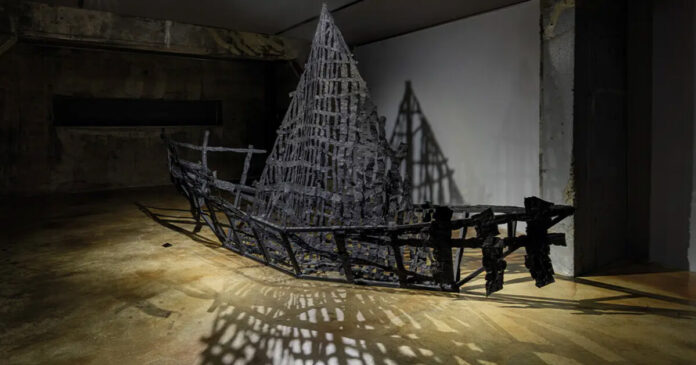
The central work, Eotieum Vessel, occupies the first chamber as a 4.3-meter-long structure built from a welded steel framework covered with thousands of individually hand-torn fragments of hanji, traditional Korean paper. These fragments are reassembled into Gyeokja (격자), a lattice-based visual language developed by the artist from traditional Korean timber screen structures. The vessel remains intentionally porous, allowing light, air, humidity, and the movement of visitors to pass through its surface. As environmental conditions shift, changing shadows are projected onto the bunker walls and floor, producing a continuously changing spatial composition rather than a fixed sculptural object.
The exhibition extends beyond the central installation through a series of interconnected works that activate movement and participation. In the connecting corridor, You May Pull the Vessel introduces a small hanji boat that the artist initially pulled through the passage before the exhibition opened. Visitors subsequently continue the same gesture, leaving no permanent physical trace while carrying the movement forward through sound, memory, and repeated action. The second chamber presents Net Hug, where a steel grid supports reassembled hanji footprints while simultaneously functioning as a physical barrier. Visitors positioned on opposite sides of the structure are able to embrace through the openings in the grid but cannot fully cross the divide. While bodies remain separated, shadows continue beyond the barrier, temporarily overlapping on the surrounding surfaces. Over time, repeated footsteps gradually crease, wear, and tear the hanji footprints, allowing the installation to record the accumulated presence of its visitors.

Eotieum Vessel, installation view of Eotieum: The Ply of Longing, Peace Culture Bunker, Seoul, 2026
Eotieum: The Ply of Longing explores movement and separation
Alongside the spatial installations, two canvas works, Longing Extends North and Still, translate the exhibition’s material language into two-dimensional form. A hanji boat is repeatedly dragged across acrylic-painted surfaces, leaving traces that become fixed within successive paint layers. Hundreds of hand-torn hanji fragments are then assembled into two hands reaching toward one another. The porous paper remains deliberately unsealed against the acrylic surface, preserving a distinction between the static painted ground and the breathable material layered above it.
Across welded steel, hanji, acrylic, light, and human movement, Eotieum: The Ply of Longing explores how material relationships can articulate memory without seeking resolution. Rather than attempting to reconstruct what has been lost, the exhibition proposes an architectural and material framework in which separation, incompletion, and displacement remain active conditions through which connection continues to exist.

Eotieum Vessel, installation view of Eotieum: The Ply of Longing, Peace Culture Bunker, Seoul, 2026

Eotieum Vessel (detail), from Eotieum: The Ply of Longing, Peace Culture Bunker, Seoul, 2026
