
Hedgehog-Inspired Network Restores Urban Eco-Connections
Urban Living Library – Reclaiming the Hedgehog Habitat by Fengyi Wu explores how landscape architecture can support biodiversity while creating meaningful spaces for people in the contemporary city. Developed as a design research project, it takes the hedgehog as a flagship species to investigate how fragmented urban habitats can be reconnected through landscape interventions. The project proposes an interconnected network of habitats, ecological corridors, gardens and outdoor learning spaces, transforming underused urban landscapes into environments that support both wildlife and everyday public life. Rather than separating ecological infrastructure from human activity, the proposal brings the two together through planting, water, shelter and carefully designed public spaces.

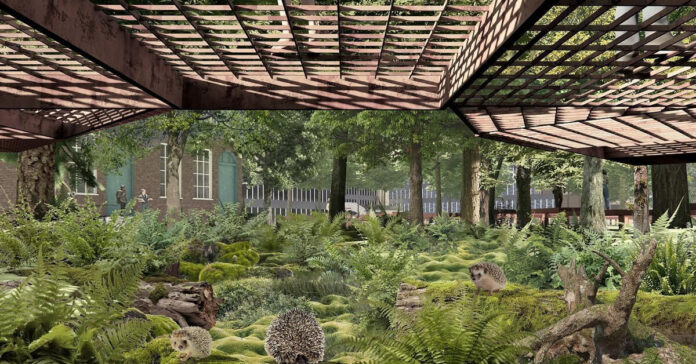
a biodiverse garden combines planting, water and habitat structures to support wildlife | all images ©Fengyi Wu
Fengyi Wu’s Landscape plan for Human and Wildlife Interaction
Designer Fengyi Wu follows a landscape strategy that combines habitat creation with opportunities for observation, learning and community interaction. Dense planting, wildlife shelters, rainwater landscapes and sheltered gathering spaces create a sequence of environments that allow people to experience urban nature while providing resources for wildlife. At its core, the project asks how cities can move beyond simply accommodating biodiversity towards actively designing for coexistence. The hedgehog becomes a lens through which broader questions of ecological connectivity, habitat loss and public engagement can be addressed, proposing landscape architecture as a tool for building more biodiverse and resilient urban environments.

a planted pedestrian landscape connects the urban environment and the new habitat network

a sheltered communal space brings people into closer contact with urban biodiversity
