
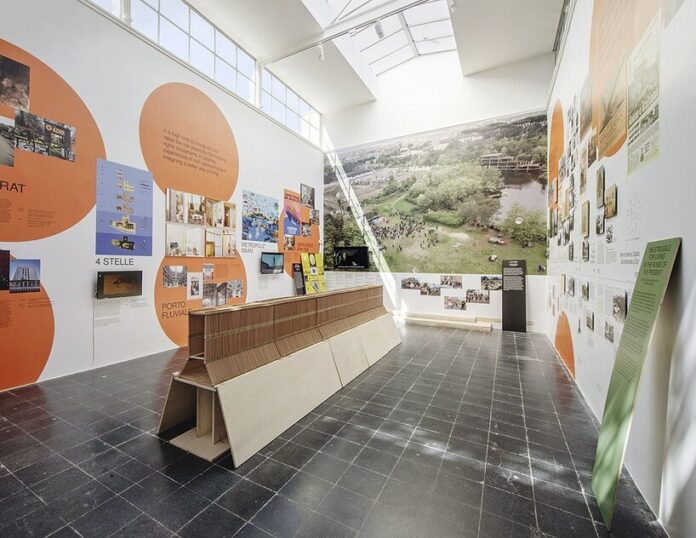
Agency for Better Living at the Venice Biennial of Architecture
At the Agency for Better Living, the installation in Austria’s pavilion at the 2025 Biennial of Architecture, one sentiment came up repeatedly among its visitors, who had come from across the globe: we can’t afford the cities we live in. Having seen this sentiment grow in urgency in recent decades, architects and curators Lorenzo Romito, Sabine Pollak, and Michael Obrist came together to compare and contrast Rome and Vienna: two European cities that have managed to provide affordable housing solutions through very different means. In doing so, they transformed the space into an ‘agency,’ where folks could come together to learn, imagine, and discuss alternative futures for the global housing crisis. One year later, the three get together to reflect on the successes and yet-to-be-answered questions that came from their laboratory in Venice.

the Agency for Better Living at the 2025 Biennial of Architecture in Venice was curated by Lorenzo Romito, Sabine Pollak, and Michael Obrist | all images © Hertha Hurnaus
In conversation with Romito, Pollak, and Obrist
When chatting with Pollak and Romito, both based in Vienna, they begin by recounting the early discussions around the Agency for Better Living as they waited for Romito to join the call from Rome. Pollak brought up that he’s been very involved in advocacy work for Spin Time Labs, an occupied space in Rome that housed over 400 people and was recently disbanded, causing its inhabitants to sleep in the street during Europe’s extreme heat waves. When Romito popped into the chat, the other two smiled to see him again before launching into a discussion on the future of our cities.

Romito’s been very involved in advocacy work for Spin Time Labs, an occupied space in Rome that housed over 400 people and was recently disbanded
Researching cities of interest for sustainable housing
‘We were starting from the housing crisis,’ Obrist remarks on how it’s increasingly difficult for not just Europeans and Americans, but city-dwellers all over the world to secure housing, both in terms of finding affordable leases and being able to own property. ‘It has to do with an incredible financialization of the housing market and a long-delayed response from a lot of governments to this kind of crisis.’
They presented their research in the Pavilion through a combination of timelines, films, and other visual media that allowed visitors to walk through the histories and contemporary discussions happening in both Rome and Vienna. ‘We involved a lot of researchers to write the texts together with us. At the same time, we did interviews with experts. We took a trip to look at both very early and current protagonists of co-housing living models and the basis of how they financed all that and how they organized it.’ She also talks about visiting Romito in Rome to learn about his work on the ground. She points out that she believes, ‘one of the biggest taboos in this work is really money,’ elaborating that, in the past, wealthier people with inheritances had a kind of unfettered access to the city. Yet since the financial crisis of 2008, ‘not having access to the city is becoming a problem for everybody.’

Obrist remarks on how it’s increasingly difficult for not just Europeans and Americans, but city-dwellers all over the world to secure housing, both in terms of finding affordable leases and being able to own property
Vienna as the ‘top-down’ model
‘But its not just low rents, it’s really a vision for society,’ Obrist says when explaining why Vienna became the ‘top-down’ model for their first case study in the Agency. The curators saw the decades of success Vienna has had in providing incredibly affordable living solutions in the form of social housing and government-subsidized homes to about 60% of its residents. This ‘vision’ isn’t just cost effectiveness, but it also comes in the form of providing services embedded in the building like, ‘swimming, active pools, public spaces, and community spaces in the house itself.’
