
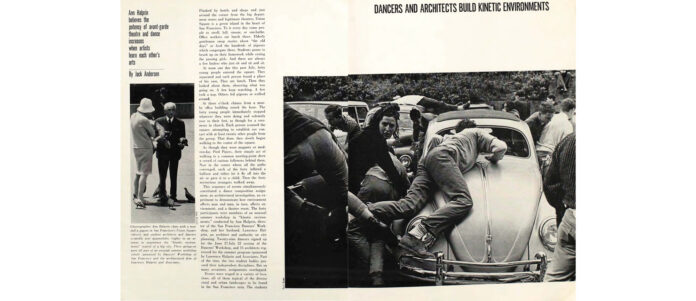
In the November 1966 issue of Dance Magazine, news editor Jack Anderson reported on an unusual summer program jointly hosted by choreographer Anna Halprin’s Dancers’ Workshop of San Francisco and her husband’s architectural firm, Lawrence Halprin and Associates. An extension of the influential teacher and dancemaker’s work in integrating pedestrian movement into choreography, improvisation, and multidisciplinary “happenings,” the workshop brought together dance and architecture students for collaborative experiments and assignments in addition to studies in their respective mediums.
One afternoon that July, the participants spent several hours in San Francisco’s Union Square observing passersby and behaving as pedestrians; then, at a predetermined time, they rose in unison and gathered at the center of the square to each inflate a balloon and release it or entrust it to a child before dispersing. In another assignment, the students worked together to build a driftwood village on a beach.

The idea, Halprin said, was born from the observation that her attempts to unite different art forms in her “happenings” sometimes resulted in a “mishmash” rather than a true collaboration, and her wondering if artists being more aware of the possibilities of each other’s practices would help. “In the past,” Halprin reflected, “I have sought to expand our concepts of theatre experience by exploding the old conventions of the dance medium and moving outward in every direction. But just to flood the audience with sensations is not enough. I want to make theatre a shared experience between performer and audience with content which deeply affects our sense of values. I don’t yet know the answers to the questions these concerns of mine raise. But I think the workshop has done much to develop my theatrical vision.”
