
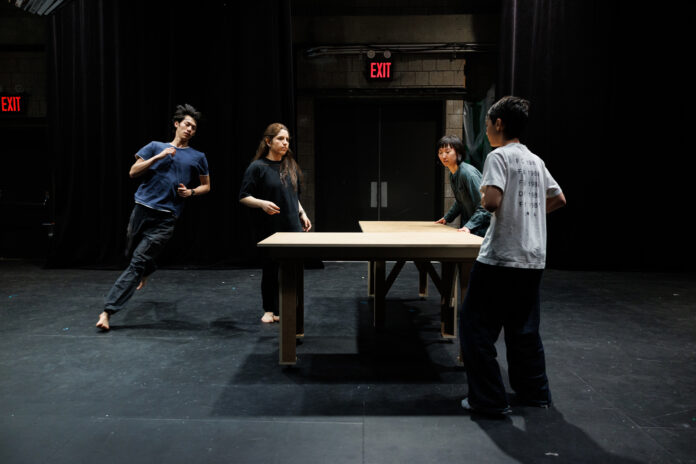
On a sunny October afternoon in Abrons Arts Center’s Playhouse Theater on New York’s Lower East Side, the air was busy with the sounds of bouncing balls, measured footfalls, and the occasional exclamation of victory or frustration. Eight intergenerational pairs of community ping-pong players were participating in a tournament, with dancers officiating, as part of artist Cherrie Yu’s work Daily Diversions. Lanky kids, sharp-eyed young adults, and seasoned elders played alongside one another, each with their own strategy and movement signature—a small flourish to their serve, a particular tension in their posture as they tracked the ball. The idea of putting the game into conversation with dance began to seem entirely natural.
For Yu, the conversation became apparent through her observant curiosity in both spaces. Born and raised in Xi’an, China, she played ping-pong as a child. She came to dance and performance in her 20s while earning her MFA at the School of the Art Institute of Chicago. “I was interested in the intersection or dialogue between bodies with very different physical knowledge and history,” she says of her early work.
A few years ago, Yu, now 31, began playing ping-pong again after encountering a player at a public table in New York’s Herald Square. It became her own daily diversion. “I would have table tennis practice early in the morning and then take the train to Cunningham class right after,” she says. “So in the very beginning those two practices and vocabularies started to have an interaction.”

Yu began making Daily Diversions in 2023 at the invitation of a Chinatown gallery. Her initial 10-minute work, performed by Yu and three Chinatown-based seniors she had been playing with, sparked something in her. “The performance wasn’t the end,” she says. “The performance was the practice—we had to keep practicing the performance.” The following year, she expanded into an “open rehearsal” format that brought dancers and players together simply to play, in addition to presenting in-process performances. Yu gathered dancers she met in dance classes around the city and players she played with in parks and recreation centers. The common thread was a sense of curiosity. “People were doing two physical practices within the same room, side by side, and that coexistence started to change the two practices,” Yu says. Her 2025–26 Performance AIRspace Residency at Abrons allowed her to house the performance—and a tournament—in a proscenium theater.
This iterative process will culminate in a series of performances at Abrons, November 12–14. Set designer Matt Schalzi’s modular, wheeled tables, which are assembled and reconfigured continually throughout the performance, have been essential from the outset. “The table is a really important performer in the piece,” Yu says. “I encourage the players to think of it less like a ping-pong table and more like a person, to relate to it through their own bodies.”
New to the work is Johann Diedrick and Isaac Silbers’ sound installation, which amplifies and composes the performance’s live sounds to give audiences an aural and spatial sense of the two languages conversing in the performance environment. The sound of the game has long interested Yu. In the performance, she says, “I want people to think that they’re making music instead of playing ping-pong.”
The eight performers, who range in age from 14 to 66, are the heart of the work, navigating choreographed passages and indeterminate, score-based structures that draw from movement vocabularies and compositional devices across the two practices. The work unfolds much like a game, Yu says: “You always play to a certain point, but whatever happens between those points is always an element of chance.”
The process of making Daily Diversions has offered Yu open-ended opportunities for exploration with the people around her. “It felt less like I was developing the work for myself,” she says, “and more for the work to grow on its own through the process of people coming into it.”
