
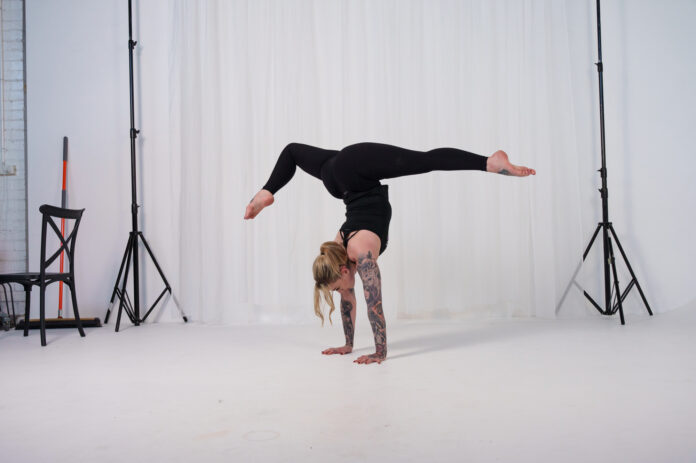
For many dancers, the arms have long been more ornament than engine. The legs power the jumps, the core anchors the turns, and the arms—well, they shape the lines. Of course, artists in floorwork-heavy styles know otherwise. But as genre-blending choreography becomes increasingly common, more dancers are asking the wrists and forearms to do something they’ve rarely had to do before: bear the weight of the whole body.
“Not only are wrists and forearms built differently than ankles, but we use them tremendously differently,” says Dr. Emily Scherb, PT, a physical therapist based in Seattle who specializes in performing and circus artists. Dancers train the ankles for weight-bearing every day—walking, jumping, landing. With awareness and strategic strengthening, dancers can do the same for their wrists to meet greater choreographic demands and avoid injury.
A Vulnerable Joint
The wrist is a complex structure: eight carpal bones arranged in two rows, nestled between the forearm and the hand, bound together by more than 30 ligaments. That architecture provides range of motion for mastering flamenco floreo or precisely placed Balanchine hands—but not natural preparation for weight-bearing.
Understanding why requires looking beyond the joint itself, because wrist and forearm injuries rarelyhappen in isolation. “Injuries in the wrist and forearms usually stem from instability or strength discrepancy in the shoulder girdle,” says Ellie Marshall, a physiotherapist and circus and pole performer based in Auckland, New Zealand, who works with The Pole Physio.
In dance, common injuries include tendinopathies (tendon pain or damage from overuse) of the wrist flexors and extensors, sprains and strains from overuse, medial and lateral elbow pain, and joint irritation from repetitive loading with the wrist in extension. Marshall frequently observes strains to the TFCC (triangular fibrocartilage complex), the small cushioning structure on the outer wrist, in pole and aerial artists. Fractures, though rarer, can occur when a dancer falls suddenly or lands awkwardly.
Scherb warns of growth-plate injuries in young dancers, especially. Repetitive impact with the wrist in extension can stress the radial growth plate, the still-developing area in the wrist joint, in adolescents who tumble, do floorwork, or practice breaking on hard surfaces. Caught early, it heals cleanly; left unaddressed, it can affect bone development.
Building Up
Dancers may experience shifts in repertoire that place sudden, new demands on the body—for example, a ballet dancer doing contemporary work that requires floorwork and weight-sharing. If possible, prepare by building upper-body strength months ahead. “If you wait until you’re asked to do floorwork, you’re not going to be ready,” says Shannon Briggs, a personal trainer and fitness educator who works with the Kilgore College Rangerettes drill and dance team in Texas. And don’t start with the wrist—begin with the shoulders. “Every muscle has two ends,” Scherb explains. “When you want something to stabilize at one end, the opposite end has to be supported too.”
For dancers with little experience bearing weight on the upper body and wrists, Scherb recommends starting on hands and knees, shifting weight forward and backward to control how much load goes into the arms. From there, progress from wrist press-ups (pressing from a flat palm up to fingertips and back) to planks, and, eventually, specific positions the choreography demands. For example, if a number requires a backbend or balancing on one hand, work up to those positions.
Scherb also recommends inverted-kettlebell carries, with the bell facing up, to challenge grip, wrist stability, and shoulder control. Briggs likes Arnold presses (bicep curls that rotate into overhead presses) for full-arm and shoulder strengthening, as well as light wrist curls. Springy floorwork drills—dropping forward into a wide squat and pushing off the hands dynamically—help build the resilient, load-and-unload capacity that floorwork demands. Both Scherb and Marshall also recommend a rice bucket, an old-school training tool that increases forearm endurance and micro-muscle strength: Submerge the hands into a bucket of dry rice and work through opening and closing the hands, in addition to moving the wrists and fingers through their full ranges including side-to-side and circular motions. For dancers who are already in the thick of it, Scherb advises including gentle upper-body weight-bearing exercises in a full-body warm-up.
Recovery and Maintenance
After heavy wrist loading or prolonged gripping, Marshall does myofascial release on the forearms with a massage ball, along with targeted stretching. Briggs advises that when a wrist feels achy, a few days of rest with a supportive brace can head off something more serious. “When we push through, that’s when we get into hairline fractures or injuries that are going to be constant and acute,” she says.
Both Scherb and Marshall urge dancers not to wait for a full-blown injury to see a medical professional. A specialist who understands dance can help build a targeted cross-training program to get ahead of injury. And pay attention to early signals—if a specific movement repeatedly causes pain, that’s a pattern worth addressing.
