
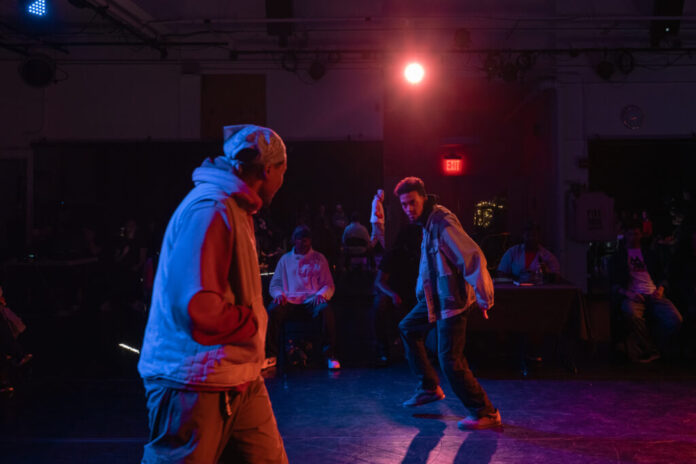
In the speculative world choreographer Quilan “Cue” Arnold created for his Lowelyfe: Turf Wars, a fractured society is losing the memories of ancestors after their mysterious disappearance. The only way to recall them is to dance—as Arnold describes it, “tapping into all the things we do specifically as Black and brown people in the street and club dance community, using our movement to transcend, to ascend, to connect with liberating philosophies, to connect with the shoulders that we stand upon.”
A three-part episodic hip-hop theater series directed by Arnold and hosted monthly at Hunter College in New York City, Lowelyfe blends street and club culture with the world-building of professional wrestling, anime, and martial arts video games. In each episode, leading characters enter dance battles, developing rivalries and relationships that become both the driving force and the distraction in combating the collective amnesia known as “The Forgetting.” The series had its first installments on September 25 and October 30, and it has one more round on December 18.
The idea for Lowelyfe derived from Arnold’s grandmother, who suffered from dementia and passed in 2024. As her dementia worsened, Arnold says, her personality changed. When Arnold watched pro wrestling with his uncle as a child, his grandmother would complain about how much she hated wrestling; after the onset of dementia, she cheered for wrestlers Cody Rhodes and Roman Reigns.
For the series, Arnold used elements of pro wrestling theatrics and culture—heroes, villains, rivalries, and the hero’s journey—and infused them with Afro-Usonian mythology, the martial arts of anime and video games, and the culture of street- and club-dance battles.
“One thing we’ve definitely taken from pro wrestling is this idea of scripted matches in the sense that we know who wins,” he says. “The cool thing about it is the process of how we get there, which is extremely improvisational.”

Arnold is working with a scriptwriter, Isaiah Godwin, to create macro-arcs for the season, including who faces who, why they’re opponents, and the dance heroes who drive the season forward. Different “Battle Blocks”—an introductory cypher, synchronized choreography, individual battles—are assembled to create scenes in each round. With the blocks in place, the dancers improvise in character to make it to the next story beat.
“We have the goal at the end of the tunnel, but then we create our own playground and path towards that goal,” Arnold says.
The Lowelyfe performers come from varying dance styles and backgrounds within the street and club dance communities, resulting in an opportunity for cultural exchange. In one rehearsal, for example, Arnold challenged performers to connect with their characters by deepening their understanding of their dance style’s ancestry. Lowelyfe performer Eli Mejia, a waacker, reflected on that dance’s legacy in queer culture and its roots in punking.
“We all come from all over the world,” Mejia says of the Lowelyfe cast, “and just seeing how everyone receives information and approaches a task differently, and how we’re all able to work together to create a full-on immersive battle, is really interesting.”
Underneath the rivalries in each Lowelyfe battle is the desire to uplift the community. “When we’re in the club, trying to split this oppressive reality that dehumanizes us or continues to keep us on the margins, whatever the bigotry is, whatever the oppressive system is—the club, the jam, these are our spaces to liberate,” Arnold says. “We’re constantly, through our dancing bodies, creating this other reality that we find freedom within.”
