
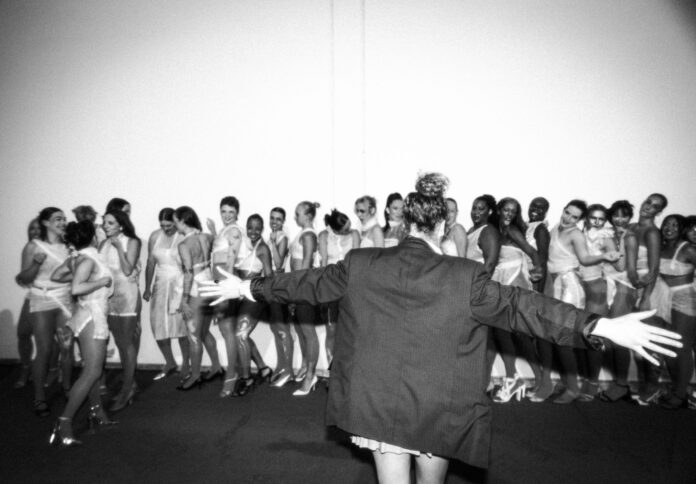
Charissa Kroeger has always felt like a dance shapeshifter. The Los Angeles–based movement artist is an alum of Loyola Marymount University’s dance program, and since her graduation in 2015, she has worked as a dancer, creative movement director, and filmmaker with big names like Zendaya, Nicole Kidman, and Lorde.
Though she arrived at the Los Angeles university with a wide array of interests, “LMU fueled every part of me and supported all the curiosities I had,” Kroeger says. “I had teachers who were working prolifically in the industry, [who taught me] so many different modalities…It was like, ‘This is why I love dance.’ ”
Kroeger’s multifaceted success in the industry since graduating is not an exception. LMU’s dance program prepares students for a diverse range of careers, and to further support that, the department recently expanded its degree offerings to include a BA in Dance, BA in Choreography and Performance, and a BA in Dance Pedagogy and Social Action. “Our world is evolving,” says dance department chair Taryn Vander Hoop. “Dance is no longer something you only go to a performance to see, and with L.A. as an extension of our classroom, we get to reimagine who we are and respond to the direction of the field.”

Program Overview
LMU dance students have until the end of their first year to select their chosen degree pathway. Students interested in the general BA in Dance degree are welcome to double-major, and many students double (or even triple!) their dancing with concurrent interests. Choreography and Performance students learn from expert artists in today’s field and have a chance for their own work to be featured in LMU’s annual student performances. The program for the BA in Pedagogy and Social Action includes options to pursue the California teacher certification, as well as the chance to extend into a five-year master’s program. Students are also able to combine both specializations if they are interested in both.
Regardless of specialization, all three degrees equally emphasize ballet, modern, jazz, hip-hop, and street styles in their technique classes, along with course requirements in dance theory, composition, dance history, and social action.
For Kroeger, LMU’s liberal arts focus on history and critique became the most important part of her education. “Being able to talk about my craft is one of my greatest tools,” she says. “Showing up with reverence for what has come before and being able to thread connections to what we’re doing now has been essential when I’m dialoguing with creative collaborators on a production.”

Los Angeles as a Professional Playground
LMU students have the dance world at their doorstep—last year, the department welcomed 200 choreographers, dance theorists, and other industry experts from the Los Angeles community and across the globe. After graduating, Kroeger landed a job as an assistant for Ryan Heffington, whose work she had already been familiar with from attending college in Los Angeles. “That job changed my life,” she says.
Senior students also take part in LMU’s Career Catapult Initiative, which brings company directors and agents to school performances. Last year, all students met with potential representation before graduation.
“The dance department model from the 1980s and ’90s was so focused on concert work and getting into a company,” says Rosalynde LeBlanc, LMU’s former department chair, current professor, and director of the school’s Bill T. Jones/Arnie Zane Company Educational Partnership. “We have made a very concerted effort to reach beyond that model.”
“One of my priorities as Chair has been to expand our professional partnerships and pipelines in dance hubs like LA and NYC, as well as globally, so students can build deep relationships with companies, directors, and representation while they’re still in school,” Vander Hoop says. The approach is already yielding results: one student was just signed through an internship before senior year, while another was offered a position with a New York City based dance company.

Looking Backward to Go Forward
Guided by the school’s Jesuit mission, LMU’s dance department prepares students to enter the industry with an eye for history, theory, and social justice.
“When you don’t have the ability to have critical analysis of what you’re seeing, then there are tiny injustices that can happen along the way,” LeBlanc says. All three degree pathways include classes like Dance, Culture, and Society: Past and Present and Dance History: Deconstructing the Western Canon. “That ethos really fuels our community,” Vander Hoop says, and this perspective is baked into LMU’s treatment of dance as a whole.
LeBlanc, for example, notes the way her own dance education was steeped in the “idea that there’s high art (concert) and low art (commercial),” but LMU pushes back against this. “Commercial dance is where Black and Brown performers were accepted when they weren’t [allowed in concert spaces],” LeBlanc says. Learning this history encourages students to engage more thoughtfully with the commercial industry.
Long-Lasting Connections With Faculty
“Our faculty are incredibly collaborative,” Vander Hoop says, and students learn from active practitioners across concert and commercial spheres.
Kroeger is living proof of the importance of these connections. “I was in a couple of Rosalynde LeBlanc’s pieces at school,” she says. “She instilled in me this ability to lead a room and cultivate curiosity in the process space. Ten years later Roz is starring in my live works, films, and most recently she danced in a music video I choreographed!”
From mentor to collaborator—this sums up the LMU experience. “Faculty relationships are really personal,” Vander Hoop says. “We offer one-on-one attention to who the students are, as opposed to who we think they should be.”
Those ready to take the next step and join LMU’S diverse community of dancers can apply here.
