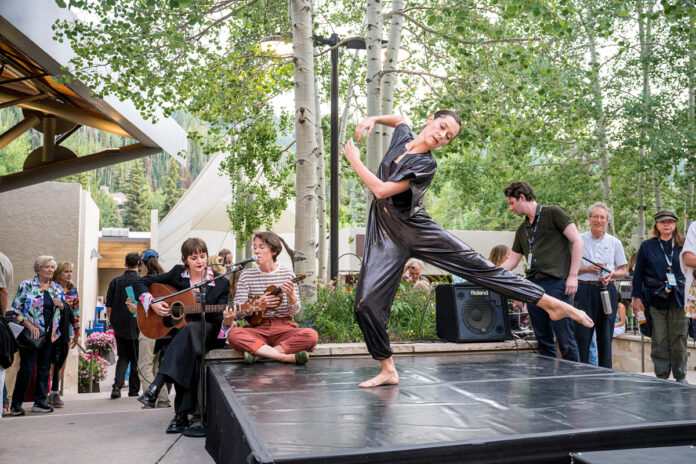
Lawsuits claiming the illegal use of recorded music for dance purposes are relatively rare. Such cases often involve high-profile violations—like a suit against “The Ellen DeGeneres Show” in 2009, when major record labels accused the series of more than 1,000 instances of copyright infringement (one for each time DeGeneres danced her way toward the stage on camera to an unlicensed recording). Dance artists performing on smaller stages might still be unaware that they need a signed agreement before pressing “play” on copyrighted music.
Nevertheless, a music misstep can be expensive as well as stressful to fix. And the atmosphere does seem to be changing. The boundaries of fair use are blurrier than ever today, thanks to an explosion of dance online and outside traditional venues.
St. Rose Music executive director Zoë Knight—who works with Nico Muhly, a composer whose pieces are often used for dance shows—says there’s recently been “a flurry of music rights issues” around Muhly’s recordings. She sees a “disconnect between dance companies, choreographers, and music publishers.”
Understanding the Process
It’s difficult for the uninitiated to understand which types of music agreements apply to which situations. For example: Using one track from one album routinely requires separate permissions from the artist (or whoever else owns the rights to the written music) and from the publisher—or publishers, plural. It might also be necessary to get permission from different publishers to use the same track in different countries.
Or securing permission might not be a dance artist’s responsibility, especially if they aren’t selling tickets or collecting other revenues themselves. BMI (Broadcast Music, Inc.), established in 1939, handles licensing for more than 25 million individual recordings. “Performers and choreographers should understand that the responsibility for obtaining a BMI music license does not fall on them,” says Jodie Thomas, assistant vice president for corporate and media relations. “That responsibility falls on the presenting organization, venue, promoter, or other entity hosting the public performance.” BMI offers different licenses for studio recitals, ticketed competitions, and touring companies.
It’s easy to get confused or overwhelmed by the process. Allowing as much time as possible to reach out respectfully to licensing organizations is important; there is no such thing as starting “too early.” “I have things programmed for the ’29–30 season already,” says choreographer and Ballet Vancouver artistic director Joshua Beamish. “Not everything, but lots of things. I’m in royalty negotiations right now for May 2028 and figuring out if we can afford a piece I really want to do.”
Small dance festivals and schools are often less stringent about securing permissions, given their constant need for new works and modest (or nonexistent) production budgets. A director, who prefers not to be identified, of free outdoor dance shows in the Midwest says she knew from the beginning that it was her responsibility to secure the rights to music used by the freelance choreographers she hires each summer. But her organization only started doing so in 2023. “Our timeline is tough because people aren’t confirmed until February or March, and then I immediately start begging them to pick music,” she says.

Negotiating Terms
A middleman who understands the ins and outs of permissions can help independent choreographers or smaller troupes, and hiring one won’t necessarily be cost-prohibitive. A person who handles music licensing for a large performing arts center or company might be open to freelancing as a broker, for example. The Midwest festival director found a broker who knew the business well and could secure her necessary agreements—roughly 10 to 25 total, depending on the year—for $2,500, which did not include licensing fees.

Composers and record labels may even grant permission for free. “I never want people to be too afraid to ask,” says musician Caroline Shaw, recipient of five Grammy awards and the Pulitzer Prize, whose dance collaborators include Justin Peck and Pam Tanowitz. “Especially if it’s coming from a student or a small organization, we’ll do our best to make it possible.” Shaw’s team says dance-related requests have increased significantly over the past decade, from just a couple in 2016 to monthly inquiries now. “The range of requests has increased too, which we love,” notes Shaw’s manager James Egelhofer. “Everything from one-off recitals to large-scale touring operations.”
Neither Shaw nor composer Mikael Karlsson, Alexander Ekman’s longtime collaborator, ask for much if the dance project is an educational experience or free to attend. On the other hand, if tickets to a show using their music start at $400, or a company wants to tour 10 venues over six weeks, that will factor into negotiations. Because the process itself costs composers money in the form of lawyers’ fees, and mixed-repertory programs or festivals usually involve multiple composers, Karlsson says he sometimes prefers a “most-favored-nation” deal. “Other people don’t always want to reveal what they’re getting paid,” he explains. Most-favored-nation status means he gets the best deal that any of the other parties negotiated. “A big publisher has someone whose job is to negotiate,” he says, “so I’m piggybacking on that.”
Brave New (Digital) World
As is true in many contexts, technology has made some aspects of licensing simpler and others more complicated. Beamish points out that Instagram and other social media platforms now offer numerous pre-licensed options for “bed music”—background tracks that play continuously during multiple video clips edited together—often including music already being used for a show, where, before, a separate agreement (typically “sync rights”) for broadcast or online use might have been required. “That does allow dance companies to advertise more easily,” Beamish says. “I feel like people from other industries don’t understand how expensive dance is and how little money it makes, so I do find that helpful.”

AI has changed the equation too, making it cheaper to produce music—and, in turn, making music cheaper to license. Mark S. Berry, founder and chairman of AMG—Music, Film & Television, says generative AI has grown to comprise “40 to 50 percent” in the films’ music supervision side of his promotion-and-distribution company’s business over the past few years. The up-front cost to a singer-songwriter who rents a studio to produce a master recording of their latest single is a small fraction of the expense incurred by a 75-member orchestra. Historically, that pushes up the price to license a quality recording of classical music, especially if royalties are paid back to each musician. Now, when someone approaches AMG to secure grand rights that could cost as much as $100,000 for a film or a major live show, Berry says he might add, “I can do an AI version for five grand.” (Consider, however, that the amount saved by dance artists using AI is arguably equal to the amount lost by professional musicians.)
Though securing music rights can be complicated and costly, Shaw says it’s an artistic as well as a legal imperative—an opportunity to compensate and celebrate the musicians whose artistry inspired the choreographer’s work. Any public presentation of dance, Shaw says, should be “a way to share and encourage love and curiosity about the music.”

Speak the Language
Here are some terms that might arise when working on music license agreements and contracts.
Most existing music is protected by some type of copyright, which grants the rights holder exclusivity to license and otherwise make money from the work. Because rights can be bought and sold, dance artists may need licenses from different holders for different pieces of music by the same artist—in addition to different licenses for the composition and the master recording.
Each unique musical recording has its own master rights and a current holder of those rights. Unless dance artists are working with musicians who will perform the music live, they typically need to contact the holder of master rights for the specific track they want to use.
The rights to a piece of music itself, regardless of who performs or recorded the piece, are its publishing rights. Some musical artists own their publishing rights and can grant permission themselves. Sometimes publishing rights are held by someone else—the person or people who wrote the music, for example.
Generally speaking, the publisher is usually the holder of the publishing rights and may not hold many (if any) master rights to recordings of the music. The record label is usually the holder of the master rights, but may not hold publishing rights to the music in general.
A rights holder may prefer an agreement for payment based on royalties, which means dance artists will owe the rights holder a portion—probably a percentage—of the money they make from the project (through ticket sales, for example). If there will just be one show or a small number of shows using the music, the dance artist and the rights holder might agree instead on a fee: a one-time payment for the run, or a set amount due per performance.
Especially if a piece of music is essentially the whole “world” of a dance—the choreography follows it from beginning to end, and couldn’t or wouldn’t exist without it—then the choreographer probably needs to secure a license for grand rights from the holder. If only part of a piece of music will be used, or it will “play in the background” in some sense, a small rights license might be sufficient.
If a dance artist wants to use a music recording for a film or video project, they probably need to secure a license for sync rights from the holder. In general, if a social media platform offers the option to use a specific recording for a post, the platform already has sync rights to that recording that extend to account holders.
A performance rights organization, or PRO, is often a liaison between the dance artist and the composer, master, or publisher. The PROs most frequently involved in the U.S. are AMRA (the American Music Rights Association), ASCAP (the American Society of Composers, Authors and Publishers), BMI (Broadcast Music, Inc.), and SESAC (the for-profit Society of European Stage Authors and Composers).
If a dance artist doesn’t have all the relevant licenses from all the holders of rights to the music their dance project uses, they might receive a takedown notice or a cease-and-desist letter. They may also be vulnerable to a lawsuit.
