Welcome to Taste Test, where every week our critic Jonah Flicker explores the most buzzworthy and interesting whiskeys in the world. Check back each Sunday for his latest whiskey review.
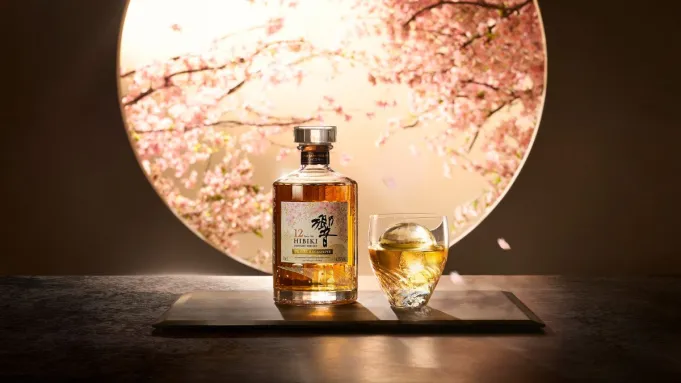
A decade ago, it was hard to find a bottle of Japanese whisky—and expensive when you did come across one on a liquor-store shelf. Demand was high and supply was low, so companies and distilleries started removing age statements from labels, disappointing their dedicated fans. Well, times have changed, and age statements are making a return. The latest example comes from Suntory‘s beloved blend Hibiki, which is bringing its 12-year age expression back to market . . . but you’ll have to head to an airport to find one for the time being.
Suntory first released Hibiki in 1989, well before the Japanese whisky craze washed ashore here in the U.S. The whisky is a blend of liquid from all three of Suntory’s distilleries—malt-whisky makers Yamazaki and Hakushu, and grain distillery Chita. Initially, there were 17- and 21-year-old expressions in the lineup, subsequently a 30-year-old was introduced in 1997, followed by a 12-year in 2009. Not all of these still exist: The 17 was discontinued in 2018 and the 12 a few years before in 2015, and today the older age statements remain exceedingly rare and expensive. A few years ago, a 40-year-old Hibiki was released, but good luck finding that one (just 400 bottles dropped with a price tag of $35,000 each).
And now Hibiki 12 is back, albeit in limited numbers and as a global travel retail exclusive. Still, this is a sign of things have shifted. A decade ago, when Japanese whisky skyrocketed in popularity, prices also rose rapidly and distilleries and brands claimed they couldn’t keep up, leading to dwindling numbers of bottles on shelves. That might have been the case, but it was also likely a marketing move. Non-age-statement expressions began showing up everywhere, replacing the numbers on the labels of classic single malts from Nikka and Suntory, which launched Hibiki Harmony as a NAS expression to satisfy consumers’ demand. Truth be told, Harmony is not a bad whisky, although it is arguably overpriced, but nothing really could match the quality of a good age-statement expression.
The new version of Hibiki 12 differs from the original, which was a blend of whisky matured in Spanish and American oak, with a small amount of whisky aged in umeshu casks (Japanese plum liqueur), too. There is no umeshu cask-aged whisky in this new version. Instead, it is built upon a base of Chita grain whisky aged in American oak and rounded out by malt whiskies aged in Spanish oak and Japanese mizunara. According to a rep for the brand, Suntory believes 15 years is the minimum length of time its whisky should spend in mizunara, so there is very likely some whisky that old in the blend, although the age statement reflects the youngest component.
Overall, this is a very good whisky, and another welcome age-statement comeback. I would have liked to try it at a bit higher proof than 86, but that’s a whole lot better than 80 and still reveals rich notes of orange, chocolate, blueberry, baking spice, vanilla, maple, honey, and warm biscuit on the palate. The brand recommends sipping this over a large ice cube, but I would suggest at least trying it neat first to really get to know the whisky.
Twelve years is a pretty standard age for a whisky (unless it’s American), so the $188 price tag feels a bit high but not exorbitant. And, of course, at the moment this is only available at just a few global travel retail locations, so it’s not like you can just head out to a store to buy a bottle (although it may become a wider release in the future). The bottom line is that Hibiki 12 is a very good whisky—maybe not as good as the dearly departed 17 or the superb 21, but it’s much easier to drink (and find) than the 30 or 40-year-old expressions. And who knows, the 17 could be next age statement to make a comeback.
Score: 92
- 100 Worth trading your first born for
- 95 – 99 In the Pantheon: A trophy for the cabinet
- 90 – 94 Great: An excited nod from friends when you pour them a dram
- 85 – 89 Very Good: Delicious enough to buy, but not quite special enough to chase on the secondary market
- 80 – 84 Good: More of your everyday drinker, solid and reliable
- Below 80 It’s Alright: Honestly, we probably won’t waste your time and ours with this
Authors
-

Jonah Flicker
