
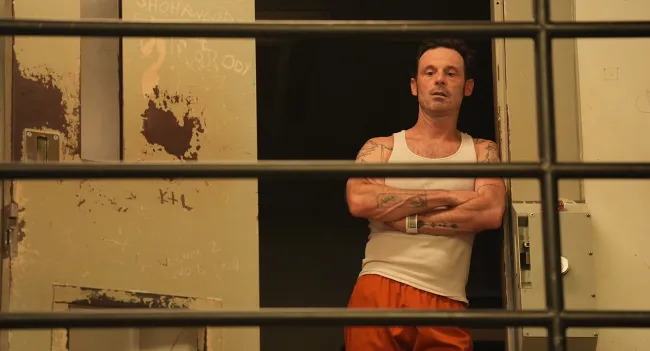
This is the final entry in an exclusive Gold Derby series following The Life and Deaths of Wilson Shedd through its Toronto International Film Festival journey. Read Part 1 here and Part 2 here.
The phone started ringing for Tim Blake Nelson the morning after The Life and Deaths of Wilson Shedd had its world premiere at the 2026 Toronto International Film Festival. Thanks to a post-screening Q&A that kept the TIFF audience in Roy Thomson Hall well past midnight, followed by a private afterparty attended by the crew and cast — including stars Amanda Seyfried and Scoot McNairy — the actor-filmmaker was running on little sleep. But he also couldn’t not answer the calls. After all, one of them would help determine the post-festival future of Nelson’s sixth feature film as a director.


That’s because the world premiere audience didn’t just include family, friends, and film buffs. Buyers from the many domestic and international distribution companies that descend on Toronto during TIFF were occupying some of the venue’s 2,600 seats as well, and they were scoping out the independently-made Wilson Shedd for acquisition. Buoyed by the positive response to the film in the room and the largely complimentary reviews that hit the internet in the ensuing hours, some of those buyers were now reaching out to Nelson with the initial overtures that precede a potential sale.

“The calls ranged from ‘We’re really interested and are going to continue discussing this’ to ‘We’re really interested,'” the filmmaker tells Gold Derby the day after Wilson Shedd‘s premiere. “I am no longer worried that this movie is not going to have have a home. It’s just a question of when and what manner of home that is.”
Any indie filmmaker will tell you that finding a home for your movie is as important a decision as finding a home for yourself and your family, with many of the same factors to consider — among them price, durability, and return on investment. That latter line item is particularly top of mind for Nelson, who in all of our conversations expressed nothing but gratitude for the film financiers that took a chance on investing in his formally and thematically daring Death Row drama. “Since I’m also one of the producers, I have to be responsible to the investors who believed in the project,” he emphasizes.
Nelson counts himself as fortunate that he has several potential options on the table and no immediate need to make a final decision on where his film ends up as TIFF 2026 winds down. But these are some of the factors he’ll be weighing as he and his partners decide which distribution label Wilson Shedd will ultimately call home.
Coming soon to a theater near you?

Nelson entered the film business during the mid-1990s when the industry was still well-populated by studio specialty labels and smaller distributors who could acquire — or even fund — adult dramas like Wilson Shedd to multiplexes and art houses relatively secure in the knowledge that lucrative post-theatrical revenue streams would send money flowing back their way. His first film as a director, 1997’s Eye of God, was released by the now-defunct Castle Hill Productions, and the subsequent efforts went out into the world courtesy of Lionsgate, Millennium Films, and IFC.
All five also followed the theatrical-to-home viewing model that was upended by the advent of the streaming age in the mid-2010s. In the current landscape, a theatrical release is no longer guaranteed unless the filmmaker makes it a make-or-break part of any deal, an ultimatum that Nelson has already told us that he’s not in a “moral position” to make.
The good news is that several of the distributors who rang Nelson up the morning after the premiere wanted to see Wilson Shedd‘s title grace a movie theater marquee as well. “There are certainly theatrical distributors among the people who are interested,” the filmmaker tells us, declining to identify them as negotiations unfold. “So a theatrical release is definitely possible.”
Nelson was heartened that TIFF buyers got to see the film play to an engaged, sold-out crowd on their first viewing — a possible coming attraction of what a limited theatrical run could look like down the road. And he’s already ensured that the movie will play in front of more full theaters as he and the interested buyers discuss potential deals; Wilson Shedd has been announced as part of the lineups at both the Hamptons International Film Festival and the Woodstock Film Festival in October with additional festivals to be announced soon.
“Pretty much wherever we applied, we got accepted,” he says gratefully. “Over the past decade, film festivals have carried the torch for these kinds of movies, as well as as for movie theaters and I love them for that. I’ll go to a festival in Nashville, Chicago, or Oklahoma City and there will be a packed house there to see a movie. These festivals have been blowing on the embers that are now catching fire again in terms of people going back to movie theaters.”
The Oscar gambit

If Wilson Shedd does ultimately land with a distributor that wants to put it in theaters, the next question is when to release it. Given the Dead Man Walking parallels — including strong star turns by Seyfried and McNairy — awards have to be part of the calculation. So could it go to theaters before the end of this year in order to ensure that it could contend for the 2027 Oscars in March?
As it happens, Nelson and Seyfried both have recent experience with a movie that tried to crash the awards race following TIFF. The director had a small role in Mona Fastvold’s The Testament of Ann Lee which Seyfried as the titular Shaker matriarch and played to an enthusiastic response at the festival’s 2025 edition. Searchlight subsequently acquired the period musical drama out of TIFF, and quickly mounted a full-throated awards push that included FYC events and Academy screenings.
But the rapid timetable left little time for the movie to cultivate an audience among the Academy, especially as the year-end avalanche of contenders set in. When the 2026 Oscar nominations were announced, Ann Lee failed to score a single nod. It’s worth noting that Searchlight took the opposite tactic with its big awards hopeful this cycle, Martin McDonagh’s Wild Horse Nine, which dropped its first trailer in March and will play three out of the four big fall festivals.
On the other hand, waiting until the following awards calendar year can be a risk as well. In 2024, Mike Flanagan’s The Life of Chuck was the surprise winner of TIFF’s People’s Choice Award, traditionally a bellwether for Oscar contention. Neon picked the film up, but held off on releasing it until the following summer where it failed to attract much audience or awards attention.
Nelson says that he’s open to hearing arguments for and against a 2026 release from the companies he’s speaking with. “It honestly depends on how a distributor perceives the movie and what strategy will get it in front of the most people,” he allows. “If that means putting it out this year, I see no reason why it shouldn’t come out this year given the responses we’ve had to Amanda and Scott’s performances.
“But if a distributor were to determine that the filed is too crowded or they don’t have enough time, then we’re going to listen to them,” Nelson adds. “These are intelligent people who do this for a living, so I’d like to hear what they have to say.”
Decision time

Asked if he’s given himself a timetable for when he’ll make a decision about Wilson Shedd‘s eventual home, Nelson says that, for now, he has the luxury of patience. “I’m not the only decision maker, but I’m certainly patient for the right offer,” he notes. “And I’m not at all impatient for just any offer, because there are encouraging discussions happening.”
So far, at least, the sales news out of TIFF’s 2026 edition is modest; the Seth Rogen comedy, Babies, was acquired by Roadside Attractions ahead of the festival, while the slasher movie, River, was purchased for $10 million by Universal and Blumhouse Atomic Monster after its Midnight Madness premiere. (At that point, the film was still owned by IFC and Shudder.) But the much-vaunted launch of TIFF’s new film market did bring a wider swath of the global film industry to Toronto this year, and Nelson thinks that renewed attention only helps indie filmmakers like himself.
“It’s hard to sell these movies now,” he notes. “But that also forces the filmmakers who makes these movies to take chances and do something that maybe others have been afraid to do. Unless you do that, you’re probably going to be consigned to coming and going as a day-and-date streaming title.”
Even if Nelson won’t emerge from TIFF with a signed, sealed, and delivered theatrical deal for The Life and Deaths of Wilson Shedd, he tells us that he feels like he’s departing town with something more valuable.
“I will leave Toronto with more hope for independent cinema than I’ve had in over a decade,” he says. “That’s because of the response to our premiere, the fact that our press screening and second screening were both, and that I’ve been stopped on the street by people wanting to talk about the movie. The audience is ready to embrace bold, daring films like the one my collaborators and I set out to make.”
