

Why does this story need to be told now?
This story needs to be told now because America has begun to ask itself again: Who belongs here? Luis Valdez’s work has always pointed to one answer — that if anybody belongs in America, the Chicano belongs here too. If America is a nation of immigrants, there’s no stronger candidate for belonging than Latinos and people of Mexican American descent. And right now, that question has become urgent in ways that feel eerily familiar.
On July 7, 2025, armored vehicles rolled into MacArthur Park in Los Angeles, where children were at summer camp. Ninety National Guard troops deployed alongside federal agents on horseback, their faces covered by tactical masks. Throughout the summer, ICE raids swept through parking lots, bus stops, and farms, targeting people who looked like they could be undocumented. Citizenship offered no protection. Appearance alone was enough. By October, the economic and social disruption was severe enough that Los Angeles County declared a state of emergency.
Eighty-two years earlier, during a different crisis, the same city asked the same question.
In June 1943, servicemen prowled the streets hunting down Mexican American youths in the Zoot Suit Riots — an unofficial search-and-destroy campaign targeting kids wearing extravagant outfits that were declarations of identity as Americans. Young men were savagely beaten, some stripped naked and left unconscious. Instead of arresting the attackers, police arrested the victims. The message was clear: You don’t belong here.
But many came from families who had been in Los Angeles for generations, some since before California became part of the United States. They weren’t immigrants. It was the border that migrated, suddenly making them foreigners in their ancestral homeland.
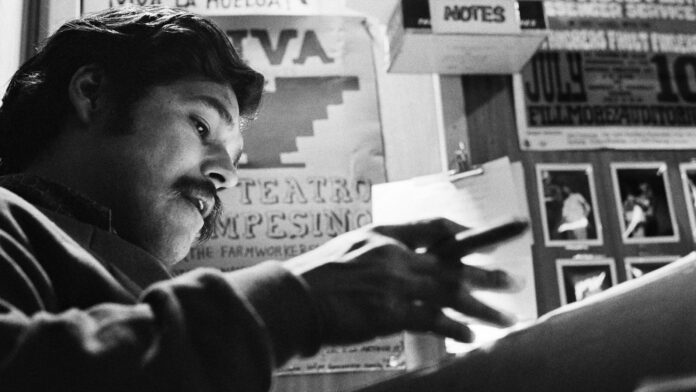
Luis Valdez understood this deeply. From his early days on the picket lines with Cesar Chavez and Dolores Huerta, his theater challenged the narrative that farmworkers were foreign laborers rather than indigenous peoples working their ancestors’s land. In 1979, his play Zoot Suit became the first Chicano production to reach Broadway, dramatizing these riots and making the case that has never been more relevant: We belong here, we’ve always belonged here, and there’s no shame in being who we are.
The Pachucos belonged in 1943. The families in MacArthur Park belong in 2025. Valdez’s life work is a reminder that this isn’t a new argument — it’s an unfinished one. And this film arrives at a moment when America desperately needs to hear it again.
What was the biggest inspiration behind American Pachuco: The Legend of Luis Valdez?
The biggest inspiration for this film was meeting Luis Valdez when I was 21 years old. He gave me the confidence to pursue a career in filmmaking that I might not have had without him. It was an honor to meet him again, 18 years later, and ask for his permission to make a film about his life.
Describe who you want this film to reach.
The people I picture in the front row are Chicanos and anyone wrestling with their own sense of American identity — those who might see themselves reflected here and feel a deeper sense of belonging in this country. Right behind them are other Americans, those who want to understand a part of our history that’s rarely taught from this perspective. My hope is that the film speaks to both groups in different but equally meaningful ways.
What was your favorite part of making American Pachuco: The Legend of Luis Valdez? Memories from the process?
I thought I could capture the majority of Luis’s life in a two-hour interview for our fundraising trailer. I quickly learned that Luis, while never wasting a single word, was extremely loquacious and had such an elegant perspective on every question that it was hard to contain his answers. By the end of that first interview, I was cutting him off and asking for shorter responses until we ran out of time. I’ve interviewed all sorts of amazing people — Bill Nye, Stewart Brand, Anthony Fauci during the pandemic — but I’ve never met somebody as voluble as Luis. And yet he never wasted a single word. It was enthralling.
When I came back to film his full life story, I booked two days, thinking that would surely be enough time. By the end of the second day — about 12 hours in — we had only reached the mid-1960s. I had to concede defeat and wait until the next year.
Once we had full funding, I booked three more days. We got close to the end on day three, but still had to rush to finish. I’m usually an extremely careful director who doesn’t like to overshoot, but I allowed Luis this space because his best answers came from working through long responses to finally land on an incredible point. I’ve never given any subject this much room before.
We filmed a total of 24 consecutive hours of interviews with Luis — something I’ve never done. I think it pays off in the film; the level of access, intimacy, and articulation of his story is exceptional. We’ll be donating the full interview to the archives at [University of California], Santa Barbara so future researchers can benefit from spending 24 hours with Luis Valdez, a legend worth remembering.
What was a big challenge you faced while making American Pachuco: The Legend of Luis Valdez?
We were extremely lucky to have American Masters and Latino Public Broadcasting come in early with small development grants — an early sign of support for an important project. But since Luis Valdez is not a household name in America, it took over a year to find the right constellation of partners to fill in the funding.
Through our production company, Insignia Films, and our producers Lauren DeFilippo, Everett Katigbak, and Amanda Pollak, we created a 15-minute teaser trailer that became a winning element for grants from ITVS, NEH, California Humanities, Ford Foundation, Firelight Media, and other incredible partners. Before the NEH grant came through, the project was on the edge of collapse. And of course, when the NEH later terminated our grant, the picture wasn’t so rosy. But we’re incredibly thankful for all our partners who helped us navigate those narrow straits to this premiere at Sundance.
Tell us why and how you got into filmmaking.
I was a high school dropout who never really had a shot at becoming anything like a successful human being. By the time I started getting into trouble with the law and becoming more rebellious, I realized how boring life could be without direction. Boredom became my greatest fear — working terrible, low-end jobs, never being excited about anything.
When I finally gave community college a try at Northlake Community College, I started thinking seriously about what direction to take. One day on the bus ride home, I stopped at a mall in Irving, Texas, walked into an AMC, and saw Punch-Drunk Love. I was blown away by how touching, mysterious, and magical it was. I walked out thinking, if I could make movies like that, I could see being excited about waking up in the morning.
That began a journey that took me to a four-year film school, then to a job at my local PBS station making documentaries, and eventually to Stanford University’s documentary film program. Today I live and work in New York City. The only thing I do is make documentary films, and I love waking up every day, brewing a cup of coffee with my kids, and then getting to work.
What is something that all filmmakers should keep in mind in order to become better cinematic storytellers?
Filmmakers should think deeply about the structure of stories — how some structures work, and some don’t. The building blocks of a good story are ultimately arcane, even if every story needs to be created with new elements.
Tell us about your history with Sundance Institute. When was the first time you engaged with us? Why did you want your film to premiere with us?
I was a producer on a film called True Conviction from 2012 to 2016. We did a Producer Summit as part of that project with the Sundance Institute, and it was an incredible experience I still think of to this day.
I wanted American Pachuco to premiere at Sundance because it’s the most important film festival in the independent landscape. I needed that kind of exposure to give us a chance to launch Luis Valdez into the popular consciousness of America. I couldn’t be more grateful for this opportunity.
