
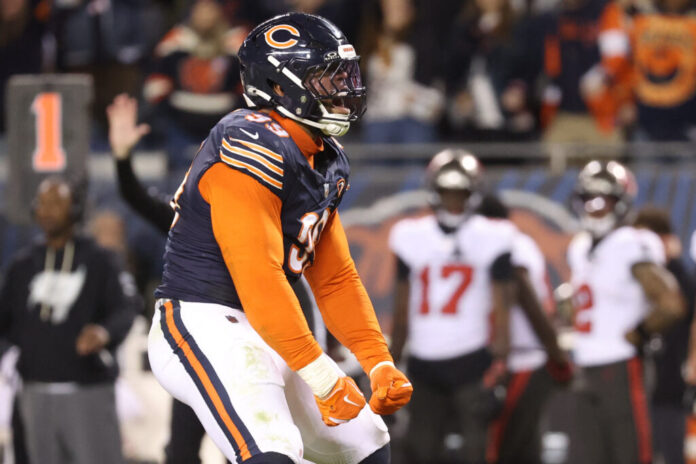
The NFL’s 2026 trade deadline is in the books. After last year saw first-round picks exchanged for Sauce Gardner and Quinnen Williams on deadline day, this year’s loudest fireworks came in the days and weeks leading up to the trading endpoint. The Bears and Jaguars combined to give up three first-round picks and a second for defensive tackles Jeffery Simmons and Jordan Davis.
 Sellers in those trades — the Titans and Eagles — received praise for those swaps as well, while the Raiders landing a third-rounder for a bridge quarterback (Kirk Cousins) was regarded as a well-executed deal. We still have plenty of time to evaluate these swaps, but that does not stop this community from weighing in on which buyers and sellers did the best work.
Despite seeing the Jay Cutler and Khalil Mack swaps not lead to sustained team success, the Bears made another deal to part with two first-rounders. They are in a better competitive position compared to when the Cutler and Mack trades took place, and Simmons’ first two games with the team showcased his high-end talent.
A four-time Pro Bowler who has three All-Pro nods — including a first-team placement in 2025 — on his resume, Simmons has been one of this decade’s best defensive linemen. The Bears acquired a player the Titans were not planning to move, as evidenced by their three-year extension this offseason.
Chicago now has Simmons signed through the 2030 season on a three-year, $105.83MM deal. Simmons’ 2027 compensation is guaranteed, and he will see his 2028 money lock in by March 2027. Simmons, 29, is older than the recent batch of non-QBs that brought back two firsts in trades; the Bears will be betting big on his age-29 season and the player’s early-30s campaigns.
Ex-Titans GM Jon Robinson made memorable misfires in Round 1, leading to his ouster, but Simmons was his best work. The Titans sold high and will have two additional first-rounders over the next two years. Tennessee made the (probably correct) calculation the two firsts — and the cost-controlled deals that come with them — would be more valuable to a rebuilding team than a DT pushing 30.
 The Titans also traded the only other remaining Robinson-era starter by shipping Amani Hooker to the Bills, collecting a second-round pick for the eighth-year safety. This represents a good return for Hooker, as the deal (Hooker and a fifth for a second) matches what the Bills paid for D.J. Moore in March. Tennessee will now hold seven picks in the first two rounds from 2027-28.
Not exactly a high-profile team, the Jaguars raised their Q rating this week by making a blockbuster trade for Davis on the same day they acquired All-Pro safety Jessie Bates and veteran DT Davon Godchaux. Criticism came in for overpayment, especially with Davis, who cost a 2027 first-round pick and a 2029 second-rounder. But the team also surrendered 2027 second- and fifth-round picks for Bates, who is in a contract year.
On the other hand, the Jags are in Year 32 as a franchise and have not played in a Super Bowl. Their quarterback (Trevor Lawrence) lacks the accomplishments of Patrick Mahomes, Josh Allen and Joe Burrow. And the Jags’ defense has not matched the recent Broncos editions; Jacksonville also exited Week 9 ranked 32nd in run stop win rate. An imposing DT presence, Davis will be tasked with turning that around. He also should help outside rushers Josh Hines-Allen and Travon Walker, who have combined for just five sacks this season.
As I mentioned in the latest PFR chat, the Jags will have exclusive negotiating rights with Bates (29) until the legal tampering period. Players entering age-30 seasons are not commonly franchise-tagged, but that will be an option for the contract-year safety. The Jags, though, have now traded five first- or second-round picks from 2025-29, with this week’s swaps coming after the Travis Hunter trade-up — which cost a 2025 second-rounder and a 2026 first. We have an “eff them picks” AFC branch now.
Although the Eagles ran into a Bengals blunder that prevented them from collecting a sixth-round pick for Arnold Ebiketie, they came out with a monster haul from two trades. Between the Davis and Cam Jurgens deals, the Eagles landed three first- and second-rounders (across the 2027, ’28 and ’29 drafts). Having made the A.J. Brown trade in June, Philly now holds 10 first- or second-round choices over the next three drafts.
 The Colts were the most active traders, by volume, making four between Chris Ballard’s firing and the Tuesday deadline. Indianapolis unloaded Quenton Nelson, DeForest Buckner, Keenan Allen and Josh Downs. Unlike the Eagles, though, the Colts fetched just one Day 1 or Day 2 pick (the Seahawks’ third for Nelson). They ended up with six extra choices in 2027, however.
Indy, though, still does not have a first-round pick in 2027 thanks to the Gardner deadline deal last year. The team passed on a Giants offer for Jonathan Taylor, which would have brought back second- and fifth-round picks, and rejected a Grover Stewart offer that would have brought back Day 3 capital. The Colts’ fire sale was overblown, as only contract-year players were dealt.
It can be argued the Seahawks came away with incredible value on Nelson, who cost third- and fifth-round picks. Nelson is the most accomplished active NFL guard, with eight Pro Bowls and six All-Pro nods. But he has since aggravated a knee injury that required surgery. A player who had not missed any time since the 2021 season is week-to-week in Seattle. Assuming Nelson returns soon, the Seahawks have an impact O-lineman. They have been able to re-sign trade pickups in the recent past. Will Nelson be a long-term Seattle cog?
Buckner requested a move back to the 49ers, and the Colts obliged. At 32 and having battled injuries in 2024 and ’25, the veteran D-tackle brought back a fourth-round pick. If Buckner stays healthy, that should bring quality value for San Francisco, which sent a 2027 sixth-rounder for Allen. Although the 49ers have a historically old collection of skill-position talent — when Christian Kirk turns 30 next week, the team will have seven skill players in their 30s — Allen remains a productive player who should help as the 49ers slowly return to full strength at WR.
With Garrett Wilson, Jerry Jeudy and Brian Thomas Jr. not moving, the wideout market was thin. The 49ers joined the Steelers, Commanders and Chiefs in pursuing Downs. Kansas City won out by parting with fourth- and fifth-rounders for Downs and a seventh.
 The Chiefs have now made four in-season WR trades since 2022, illuminating the issues the franchise has experienced here since trading Tyreek Hill in March 2022. Downs gives the Chiefs a more reliable weapon — one that has not played with an above-average quarterback to date — compared to Rashee Rice and Xavier Worthy, though the 6-2 team should have all three playing together once Worthy recovers from a hamstring injury.
The biggest name moved came at quarterback. After a dismal Carson Wentz Monday outing, the Vikings sent the Raiders their 2027 third-rounder to reacquire Cousins. Minnesota had initially sent Las Vegas a lesser offer, but the proposal increased on deadline day.
While the Vikes retained the Eagles’ third-rounder obtained for Jonathan Greenard in April, their urgency was on display via a Day 2 choice exchanged for a 38-year-old passer. As the Raiders turn to Fernando Mendoza, an extra third-rounder will help their rebuild around the 2026 No. 1 pick.
Even though they happened earlier in the season, we can also include the J.J. McCarthy, Joey Porter Jr. and Marvin Harrison Jr. swaps in this bunch. So, who came out best? Vote in PFR’s latest poll and weigh in with your deadline thoughts in the comments section.
