
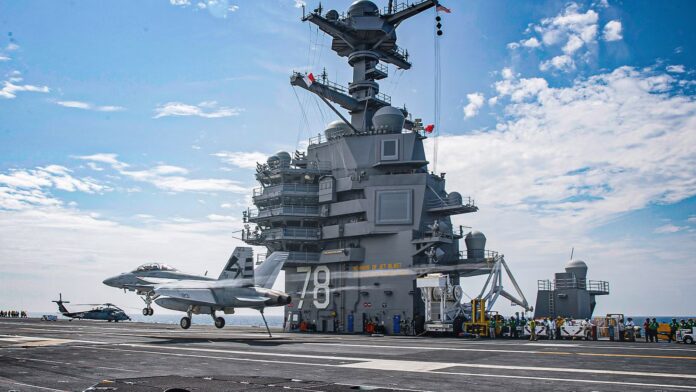
The fourth Gerald R. Ford-class supercarrier, USS Doris Miller (CVN-81) is facing delays that have pushed the schedule back from 2032 to 2034. The protracted construction of the vessel is now expected to take 15 years before completion and has raised questions about its Electromagnetic Aircraft Launch System, which has already proven to struggle on the USS Ford (CVN-78). EMALS has had issues launching Boeing F/A-18 Super Hornets and EA-18 Growlers with particularly heavy payloads, like external fuel tanks.
This is a critical mission capability for US Navy carrier air wings deployed with the carrier strike group. The  Boeing MQ-25 Stingray uncrewed aerial system offers an alternative to fulfill the ‘Buddy Tanker’ mission for air wings, but it is still years from entering mass production and joining frontline squadrons. Simultaneously, having the drone would not eliminate the need for drop tanks on strike fighters.
Even President Donald Trump has weighed in on the controversy, offering his opinion to back detractors who argue the future Ford-class hulls should revert to legacy steam catapult systems. Reverting to steam over EMALS would essentially send the entire vessel back to the drawing board, as it is one of the core systems on the colossal 100,000+ ton warship that takes decades and costs tens of billions of dollars.
Modernizing Carrier Aviation In The US Navy

The Ford-class of supercarriers is expected to include ten vessels, with the entire program budgeted at $120 billion. The leadership in the class, USS Ford, reportedly cost $13 billion upon completion. Packed with a litany of innovative new technology, never before seen in American naval aviation, it has not been without its challenges. Chief among the technical hurdles faced by CVN-78 is the high-profile shortcomings of EMALS.
The preceding Nimitz-class aircraft carriers currently make up ten of the eleven hulls in the active fleet. All of these ships use steam power for the catapult-assisted takeoff that powers them before launch points on the flight deck of each ship. The USS John F. Kennedy (CVN-79) will not join the fleet until early 2027. The two-ship block buy for the USS Enterprise (CVN-80) and USS Doris Miller (CVN-81) was designed to establish a highly efficient manufacturing cadence. However, early supply chain difficulties have already caused the schedule to slide to the right.
Reverting from EMALS back to legacy C13-2 steam catapults on a Ford-Class hull is an incredibly complex engineering challenge, rather than a simple swap of components. The Ford-Class was designed from the keel up around an all-electric architecture. To that end, the Bechtel A1B nuclear reactors also generate roughly three times the electrical capacity of a Nimitz-Class carrier. Reverting to steam would require retrofitting massive steam generation blocks, cross-deck piping, and water-brake systems into a hull that lacks any free space.
Bad Vibrations On The Flight Deck

The trouble with the Ford-class EMALS is not that it can’t launch Super Hornets into the air, but rather that it does so too harshly, putting undue wear and tear on the jets every time they take a ‘cat shot.’ Testing showed that F/A-18E/F Super Hornets and EA-18G Growlers carrying full 480-gallon external fuel tanks experienced severe, out-of-tolerance structural vibrations. In response, the Navy introduced a software patch intended to minimize vibrations without sacrificing launch power, according to Military.com.
The specific concern with this characteristic is the stress placed on the jets when they are loaded with heavy underwing munitions or fuel tanks. The linear motor’s rapid acceleration profile induced a violent longitudinal harmonic oscillation. This ‘pogo effect’ generated excessive force on the wing pylons and fuel tank attachments, threatening to drastically reduce the fatigue life of the airframe, according to the USNI.
Critics argue that a software patch is just a compromise and not a definitive engineering solution. This is based on the fact that reducing oscillation requires the system to soften initial acceleration in the launch sequence. Critics argue that this leaves virtually zero margin for error. If environmental conditions degrade or the power grid dips during launch, the catapult cannot spike power to compensate without immediately reintroducing the destructive vibrations.
The Case For EMALS Over Steam Power

The Navy did not just put EMALS on the Ford-Class as a cool gadget; the entire ship was built around it. The Navy pursued the development of EMALS in the first place to address the inevitable scaling up that would be required as naval air warfare continues to evolve in the 21st century and beyond. The future of the carrier strike group and the carrier air wing has essentially been shaped by EMALS at its core.
Eliminating the sprawling steam infrastructure freed up vast amounts of internal volume, and it charges in a fraction of the time required for the steam catapult, which is intended to give a 25% to 30% higher daily launch. Both of these elements are critical as the Navy requires larger hangar decks for Lockheed Martin F-35C stealth fighters and plans to introduce more drones to the Air Wing, which will be launched and recovered more frequently than crewed aircraft. Additionally, when functioning correctly, EMALS should impose far less wear and tear on these ‘exquisite’ jets, extending their service life as well.
Another crucial operational aspect in which EMALS helps the Navy future-proof its fleet compared to steam is the simplicity and accuracy of adjusting the power per launch for each airframe. Steam pressure is notoriously difficult to fine-tune on the fly and, in some cases, cannot be reduced to a low enough pressure to safely launch a drone at all. EMALS can launch a featherweight 10,000-pound (4,500 kg) reconnaissance drone in one shot, and instantly recalibrate to launch a max-payload, 85,000-pound (39,000 kg) heavy strike fighter 45 seconds later.
The Course Ahead For America’s Navy

For argument’s sake, disregard the possibility of EMALS being removed in favor of steam power, and instead, the Navy pushes forward with the current design. Now, consider the future strategic landscape of naval power around the globe as it unfolds in the shipyards of America and its greatest near-peer adversary, China. The People’s Liberation Army Navy has made leaps and bounds in blue-water sea power in recent years. So much so, its fourth aircraft carrier is expected to be a true rival to America’s fleet.
The Type 004 will be the fourth aircraft carrier in the PLAN and builds upon the progress made in the recently launched Type 003 Fujian. Fujian is a conventionally powered vessel, but it was just five years behind the US Navy in launching an aircraft off its deck using an electromagnetically powered catapult, and a stealth fighter no less. It is also the first flat-top carrier in the Chinese Navy, eliminating the ski jump.
The Type 004 is expected to take this even further with nuclear power and a displacement of over 100,000 tons that will rival the Ford-class. Its air wing will be 70 to 80 strong, composed of Shenyang J-35 stealth fighters, drones, and new airborne early warning aircraft akin to the US Navy’s Northrop Grumman E-2 Hawkeye. When the vessel launches, it will be an exact analog of the American capital ships, which are its chief rivals for dominance of the East China Sea.
The People’s Republic of China is expected to use its newfound blue water power to project power far beyond its immediate region. The PRC has made significant inroads in the Middle East and Africa and even established its first expeditionary base in Djibouti. At the same time, it continues to develop airfields and naval stations on small islands in the First Island Chain.
The addition of a fourth aircraft carrier, with greater capability than ever before, will enable it to contest US allies in the second island chain and on the high seas worldwide. This creates an urgently pressing strategic imperative to commission the new Ford-class vessels and not delay the modernization of American carrier aviation.
The Needs Of The Navy

The Ford-class was intended to provide the US Navy next-generation capabilities that cannot be matched by the PLAN or any other adversary. Delaying the introduction of the follow-on hulls not only negates any technical superiority but cedes strategic advantage decades in the making. Purely from a logistical point of view, the decision to upend the entire design of the future Ford-class ships would destroy the US Navy’s fleet plan for the coming decade.
Reverting the Ford-class to obsolete technology would be a catastrophe for the Navy’s mission capability at every level of fleet readiness. The Navy would have to pay billions of dollars to naval architects just to figure out how to redesign the ship. The partially constructed hulls would have to be ripped apart to completely reallocate space inside for the massive steam power system. Billions of dollars spent researching, manufacturing, and refining EMALS components, power-conditioning electronics, and energy-storage rotors would instantly become worthless dead weight.
Then there is the simple fact that it is no longer a simple task to build a steam catapult, with production ending years ago after the final installation of a Nimitz-class C13. All the required tooling and skilled labor have evaporated. Forcing a pivot back to steam would require the Navy to spend years and billions of dollars just to rebuild an obsolete supply chain from scratch, recreating manufacturing tools that were state-of-the-art in the 1970s.
Even if this Herculean feat of supply chain reorganization were possible, it would undo the entire fleet modernization strategy for the carrier air wing. Steam catapults lack the delicate control necessary to launch lightweight, fragile drone airframes without ripping their nose gears off. Canceling EMALS effectively means the Navy could not field a modern, uncrewed carrier air wing. The future fleet would be locked into launching heavy, piloted aircraft, falling entirely behind the automated and distributed aviation concepts that China is actively developing.
The process of halting construction, redesigning the hulls, and trying to resurrect a dead steam industrial base would introduce a catastrophic five-to-seven year delay for every remaining ship in the Ford-class. Meanwhile, the Nimitz-Class carriers will hit their hard 50-year structural ceilings and must retire. The US carrier fleet would plummet from 11 hulls down to 8 or 7 as delayed ships finally complete certification trials. This creates massive coverage gaps in the Mediterranean, the Middle East, and the Pacific, just as the US’s top adversary is at its highest level of capability in history.
Catch what other trackers miss
Emergency squawks, holds, NOTAMs — live signals, no signup.
Open tracker
Catch what other trackers miss
Emergency squawks, holds, NOTAMs — live signals, no signup.
Open tracker
