
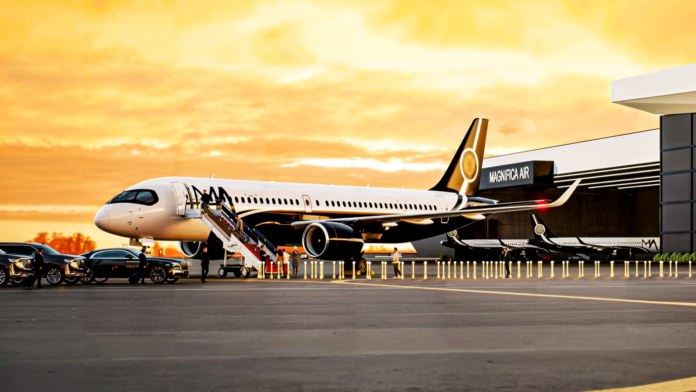
Magnifica Air plans to start operations in 2027 and will utilize a fleet of Airbus A220s along with a handful of A321neos. While the concept is similar to JSX’s business model, the actual execution is more similar to an airline offering only first class seats and competing against private jet charter companies on price. Most airline start-ups target budget customers, so this is one of the most unique new companies in recent years. However, the industry is extremely unkind to new entrants, and so it remains to be seen whether Magnifica’s business model will succeed.
Magnifica Air’s Business Model and Operations

Unlike most new airlines, which usually focus on a low-cost business model, Magnifica Air is targeting the ultra-luxury travel market. Based in Florida, Magnifica intends to begin operations in the third quarter of 2027 with a fleet of six A220-300s and two A321neos. It has signed lease agreements with Air Lease Corporation and Azorra for the eight aircraft, and it has already taken delivery of its first aircraft, an A321neo formerly flown by Spirit Airlines. The carrier aims to operate over two dozen aircraft within just a few years of operations.
These are logical aircraft for a start-up, but what makes Magnifica unique is what’s on the inside. The A220s will have a capacity of just 45 passengers, equipped with recliners similar to US domestic first class seats, whereas the A321neos will be equipped to carry 54 passengers. Both types will also offer private suites at the front of the cabin, while the A321neos will be equipped with a lounge at the rear of the aircraft. In essence, the airline is aiming for the ultra-high-end travel market, above any other airline.
In addition, Magnifica is promising private terminals with brisk TSA screening, white-glove baggage handling, and chauffeur services. It promotes that passengers may be able to arrive at the airport just 30 minutes before their flight, and will also offer lounge access to all passengers. In addition, Magnifica will offer the ‘Seven Club‘, which will essentially be a private membership that offers fixed-rate pricing and priority services, among other benefits.
What Makes Magnifica Different From JSX

JSX has been operating for years with a similar selling proposition, in that it offers customers a near-private jet experience. However, JSX is focusing less on the luxury aspect of private aviation and more on convenience, as the airline’s true strength is that it operates out of FBOs (fixed-base operators), just like general aviation operations. Security screenings are much quicker than in an airport terminal, and this means that customers can arrive at the airport just 30 minutes before the flight.
Of course, flying with JSX is a more elevated experience than with the airlines, with comfortable seats and thoughtful onboard service, but the convenience of using FBOs is the main selling point. The company technically operates under Part 380 regulations, where it charters flights that are technically operated by a subsidiary flying under Part 135 regulations, and then sells the seats as if the flights were scheduled. This regulatory ‘loophole’ allows it to use FBOs rather than airport terminals while still presenting itself to customers as an airline with scheduled flights.
|
FAA Flight Operation Regulations |
Description |
Examples |
|---|---|---|
|
Part 91 |
Regulates non-commercial flying |
General aviation flights, repositioning and maintenance flights by commercial operators |
|
Part 121 |
Regulates scheduled commercial service with large aircraft, pilots must hold an ATPL, most stringent operational and maintenance regulations |
Large passenger, cargo, and charter airlines |
|
Part 135 |
Regulates commercial on-demand charter and commuter service with low-capacity aircraft, pilots must hold a CPL, with less stringent operational and maintenance regulations than Part 121 |
Kalitta Charters, Wheels Up, Boutique Air, Counter Aviation |
Magnifica, on the other hand, is seeking Part 121 certification, which is the same set of regulations governing large commercial airlines. It won’t be using the same screening facilities as JSX, and although it’s promising to use dedicated facilities with brisk security, convenience isn’t the primary focus here. Instead, Magnifica Air appears to be focusing mainly on pure luxury, with its product offering sitting even above first class, but this also raises questions as to the viability of the business model.
The Real Benefit Of Private Jet Travel

JSX and Magnifica Air are both attempting to sell a ‘private jet lite’ experience at a lower price point, mimicking aspects of private aviation but without actually flying true ‘private’ jets. The challenge for Magnifica, however, is that the JSX business model is more closely aligned with what private aviation flyers actually desire, which is convenience and time-saving. Most corporate aircraft types are arguably less luxurious and comfortable than high-end long-haul first class products, but people with the means fly private because of time rather than opulence.
Private jets leave at essentially any time the passenger needs, and because there’s no check-in or security, passengers can arrive just minutes before the flight. Because you’re flying either on your own or with a group of familiar people, there’s no need to wait for boarding, or to wait for boarding to finish. You simply arrive at the FBO, walk onto the plane, get seated, and then the jet starts moving. Combined with the same process upon arrival, flying private ends up cutting hours from trips.
Magnifica is promising lower prices than private jet charters, and it’s also advertising quick airport times. However, as a Part 121 carrier, it will be required to use TSA-approved security screening facilities. The fast airport times are meant to come from new/repurposed facilities used solely by Magnifica, but it’s unclear how this will actually be executed. Even if Magnifica Air does deliver on these promises, it’s clear that luxury is a much larger focus for the airline than for some private jet customers, since comfort and opulence are more of a secondary benefit.
The Challenges With Magnifica Air’s Business Model

Regular private jet customers are not going to switch their allegiance to a new start-up airline that offers a similar experience, except that it is less private and likely less convenient. Magnifica will be competing in a similar space as JSX, but Magnifica is placing more emphasis on the quality of the passenger experience rather than on convenience. With this in mind, not only will the airline be competing against JSX, but Magnifica Air will also compete against the US legacy carriers, and this will create a very unique market dynamic.
Delta Air Lines and United Airlines have been very successful at targeting the premium market, and Magnifica is betting that passengers will pay even more money for its upgraded recliners and private suites. However, Delta and United’s premium focus works in part because they already have competitive schedules, wide-reaching networks, desirable loyalty programs, international partners, and more. The premium push works in part because it’s used as a point of differentiation that allows these airlines to command higher fares.
Magnifica is centering on this as its primary selling point. The top of the market isn’t being targeted by any airline, so this could prove to be a lucrative space for the ambitious upstart. However, the carrier will face challenges since, by positioning itself between premium airline products and private jets, it’s essentially looking to steal customers from both markets. It then needs to give them a reason to switch to Magnifica, and luxury alone might not be enough.
It’s planning to initially serve Miami, New York, Los Angeles, Dallas, Houston, the San Francisco Bay Area, and more in the future. It’s a logical route map, but the US legacy carriers serve hundreds of destinations, while private jets can go to any airport. Will this network be sufficient to pull passengers away from airliners and business jets? It’s structuring its Seven Club more like a jet card rather than an airline’s loyalty program. Will this be attractive to elite airline frequent flyers and current jet card holders?
The Next Steps For Magnifica Air

Magnifica Air has lease agreements with Air Lease Corporation and Azorra for aircraft, while its first plane is already on property wearing the Magnifica livery (and branded as an ACJ321neo, interestingly enough). It has multiple sources of funding, and the new company’s leadership is well-seasoned in commercial/private aviation. It’s not a theoretical company, and it’s more likely than not that Magnifica Air will soon begin operating scheduled flights.
Magnifica Air is proceeding through the FAA’s Part 121 certification process, and hopes to receive its Air Carrier Certificate later in 2026. From there, the new company will take several more months to finalize its business and operating practices, aiming to start flying passengers in the third quarter of 2027. From there, the real challenge will start.
Given the popularity of premium travel in the United States, there is merit to the idea of an airline occupying the space between premium airline products and private aviation, which is also rising in popularity. Given that it’s a fairly novel concept, it’s difficult to predict the viability of the company’s plans. Still, it will be asking customers to spend massive amounts of money while switching from their preferred brand to a new, unproven airline, and costs will be extremely high. Even when targeting the top of the market, the airline industry is a challenging business.
