
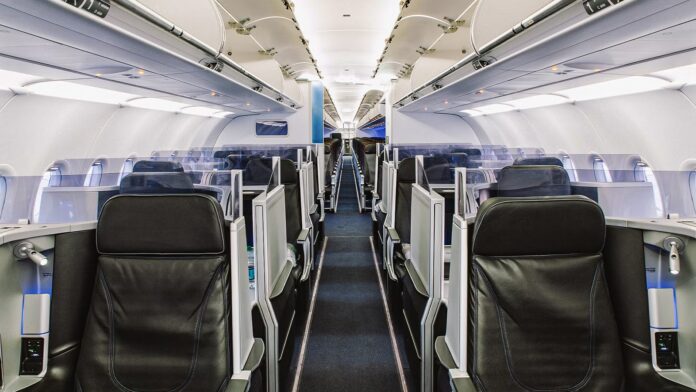
JetBlue Airways is making its largest-ever Mint push from  Fort Lauderdale-Hollywood International Airport (FLL). Starting on November 19, the airline will launch daily Mint service to
  San Diego International Airport (SAN), adding another transcontinental market to a schedule that is already being built around premium flying out west. This winter, JetBlue also plans to offer up to eight daily flights from Fort Lauderdale to Los Angeles and up to three daily flights to San Francisco.
But the real story is not just one new route. It is the scale of what JetBlue is trying to build at Fort Lauderdale. The airline says that it expects to reach 150 daily departures from the airport this winter, up more than 75% over the same time last year, while turning Mint into the premium anchor of its westbound network. For an airline still trying to restore profitability through its JetForward plan, Fort Lauderdale is becoming one of the clearest tests of whether a more focused, more premium JetBlue can work.
Fort Lauderdale Is Becoming A Major JetBlue Platform

JetBlue’s Fort Lauderdale expansion has moved rapidly. Just a year ago, the airline operated an average of 72 daily departures from FLL, and was the second-largest airline at the airport behind Spirit Airlines. However, as Spirit went through its second round of restructuring, JetBlue started doubling down in South Florida, such that by mid-winter it was up to 95 daily departures and had become the largest carrier at FLL.
JetBlue kept turning up the heat during the spring, surpassing 20 new routes and increasing frequencies across many others, taking it to 130 daily FLL departures by the time the summer schedule rolled around. Now the carrier says that by winter 2026, it expects to operate more than 150 daily flights from Fort Lauderdale, its largest-ever schedule from the airport.
That has radically transformed the positioning of FLL within JetBlue’s network. To put it in perspective, Fort Lauderdale is approaching the scale of JetBlue’s largest base,  New York JFK Airport (JFK), where it operates approximately 180 daily flights. It will shortly surpass the 130 daily flights from
  Boston Logan International Airport (BOS), which has long been one of JetBlue’s defining East Coast franchises.
|
JetBlue Base |
Average Daily Departures (JetBlue reported) |
|---|---|
|
New York (JFK) |
180 |
|
Fort Lauderdale (FLL) |
150 (by winter 2026) |
|
Boston Logan (BOS) |
130 |
|
Orlando (MCO) |
70 |
|
San Juan (SJU) |
45 |
The market share picture also underlines the shift. OAG data shows that JetBlue’s departing-seat share at FLL rose from 19% in June 2025 to 34% just a year later. At the same time, JetBlue has also said that Fort Lauderdale is beating its projections, with revenue per available seat mile up 5% when the carrier reported its Q1 2026 results. In other words, this is not only about adding capacity. JetBlue says the market is exceeding its expectations for financial performance.
Catch what other flight trackers miss
Emergency squawks, holds, NOTAMs — live signals, no signup.
Open tracker
Catch what other flight trackers miss
Emergency squawks, holds, NOTAMs — live signals, no signup.
Open tracker
With all of that in mind, it makes logical sense for the carrier to now push to add more JetBlue Mint capacity from Fort Lauderdale. Not only does it help differentiate JetBlue’s offering, providing a distinct advantage over the legacy carriers, but it also offers JetBlue the opportunity to increase yields on its FLL routes. As such, it’s no surprise that, this winter, JetBlue will be operating its largest-ever Mint schedule from FLL.
Fort Lauderdale-San Diego Is The Latest Transcontinental Mint Route

The new daily Fort Lauderdale-San Diego flight gives JetBlue another long-haul domestic route from FLL, and it is exactly the type of sector where Mint makes sense. At nearly six hours eastbound and more than 2,200 miles, FLL-SAN is long enough for a lie-flat premium seat to really matter. JetBlue’s published schedule has the westbound flight leaving Fort Lauderdale at 7:00 AM and arriving in San Diego at 9:39 AM, with the return leaving San Diego at 11:00 AM and arriving back in Fort Lauderdale at 6:55 PM.
JetBlue won’t have the route to itself.  Alaska Airlines will begin operating daily from November, using a Boeing 737-900, while
  Southwest Airlines will also add FLL-SAN to its winter schedule, flying the route up to five times weekly using a Boeing 737 MAX 8.
|
Fort Lauderdale – San Diego Route Details |
|
|---|---|
|
Launch date |
November 19, 2026 |
|
Frequency |
Daily |
|
Westbound Schedule |
B6-529. Departs FLL at 7:00 AM; arrives SAN at 9:39 AM |
|
Eastbound Schedule |
B6-532. Departs SAN at 11:00 AM; arrives FLL at 6:55 PM |
|
Route Distance |
2,263 miles |
|
Nonstop Competitors |
Alaska Airlines (737-900); Southwest Airlines (737 MAX 8) |
Alaska Airlines brings  oneworld loyalty appeal and a strong West Coast brand, while Southwest brings fare pressure and broad leisure recognition. JetBlue’s answer is Mint. It is entering a competitive market and betting that the product gap matters. The airline says it “will offer the only business class option between Fort Lauderdale and San Diego, giving customers a more comfortable and premium way to travel.” It is betting that Mint is a clear point of differentiation versus competitors.
What makes this new route announcement particularly interesting is that it comes hot on the heels of JetBlue having just cut its routes from  Newark Liberty International Airport (EWR) to Las Vegas and Los Angeles, both of which were also Mint service. This is therefore the clearest indicator possible that the carrier is adjusting its transcontinental routes and realigning its most valuable assets to the bases where it believes it will be most competitive and derive the most income.
LAX & SFO Give The Schedule Its Scale

San Diego is the new route, but it is the capacity increase to the carrier’s other two California destinations that will give the Fort Lauderdale Mint schedule real weight. JetBlue is planning to increase its number of Mint flights to  Los Angeles International Airport (LAX) from the current level of five daily flights to up to eight daily flights this winter.
That is a major commitment on any transcontinental route, but it matters even more because frequency is part of the premium product. A lie-flat seat is valuable, but so too is being able to choose the right departure time. Los Angeles is the anchor market for JetBlue on the West Coast. It is large, visible, premium enough to support Mint, and leisure-heavy enough to fit JetBlue’s brand
|
California Destination |
Winter Mint Plan |
Why It Matters |
|---|---|---|
|
Los Angeles |
Up to 8x daily |
Anchor transcontinental market that combines Mint with schedule depth. |
|
San Francisco |
Up to 3x daily |
Bay Area premium route. |
|
San Diego |
1x daily from November 19 |
New Southern California route where Mint can stand out. |
With up to eight daily Mint flights, JetBlue is not merely offering a token premium option. Rather, it is trying to make itself the default carrier for customers who want to fly between South Florida and Los Angeles with a better onboard experience.
 San Francisco International Airport (SFO) plays a different role. While it is smaller than Los Angeles, it is still very valuable because of Bay Area demand and technology links and United’s strength at SFO. JetBlue currently operates the FLL-SFO route twice daily, but plans to offer up to three daily Mint flights this winter. That gives it enough frequency to be relevant while still keeping the route focused on premium demand rather than pure volume.
The Competitive Map Shows Where Mint Matters Most

JetBlue operates transcontinental Mint service to five destinations from Fort Lauderdale, just a fraction of the more than 60 routes that it operates from its South Florida base. These include the three West Coast destinations already mentioned, as well as  Harry Reid International Airport (LAS) in Las Vegas, and
  Phoenix Sky Harbor International Airport (PHX).
The former is the only route where the carrier has no competition and is able to benefit from a strong presence at both ends of the route to drive demand for a thrice-daily service with its premium offering. Los Angeles is the opposite. JetBlue is competing against  Delta Air Lines and
  United Airlines, who both fly the route twice daily.
The legacy carriers have the hub effect and the advantage of their loyalty programs. However, JetBlue’s superior Mint service and far higher frequency mean that its proposition is hard to ignore.
|
Destination |
JetBlue Frequency |
Nonstop Competitors |
|---|---|---|
|
Las Vegas |
3x daily |
– |
|
Los Angeles |
Up to 8x daily |
Delta Air Lines (2 x daily, A321neo); United Airlines (2 x daily, 737 MAX 9) |
|
Phoenix |
2x daily |
American Airlines (Daily, 737-800) |
|
San Francisco |
Up to 3x daily |
United Airlines (2x daily, 737 MAX 8) |
|
San Diego |
1x daily from Nov. 19, 2026 |
Alaska Airlines (Daily, 737-900); Southwest Airlines (5 x weekly, 737 MAX 8) |
Similarly, JetBlue faces United’s hub presence at San Francisco, and takes on  American Airlines at its Phoenix hub. However, in both cases, it offers a higher frequency, making it the more convenient carrier to book with. It is also offering a superior premium product compared to the business-class recliners found on the legacy carrier aircraft, and in the case of American, a superior economy seat with in-flight entertainment as well.
The net effect is that JetBlue will be offering up to 17 daily Mint-based transcontinental flights from Fort Lauderdale this winter. It will be taking on entrenched legacy carriers that have the benefit of corporate contracts and loyalty bookings. However, it is betting that by offering a superior premium product and higher frequency, along with its increasing dominance at FLL, it can win out with the leisure and VFR travelers looking to travel to and from South Florida.
Mint Is The Product That Makes The Bet Credible

Mint is the reason this expansion is different from a conventional leisure capacity grab. A standard narrowbody route can fill seats and still struggle if fares are low: just ask the financial team at Spirit. Mint gives JetBlue a way to acquire higher revenue per flight on long domestic sectors, especially when passengers are choosing between a basic nonstop, a legacy connection, or a drive to another airport.
The product is also easy to understand. JetBlue describes Mint as offering fully lie-flat seats, premium hospitality, and curated dining. For passengers, the practical appeal is straightforward: a better seat, more privacy, better food, free Fly-Fi, seatback entertainment, and a more premium version of the JetBlue experience. On a five-to-six-hour route, those things matter.
|
Mint Feature |
Passenger Benefit |
Commercial Value For JetBlue |
|---|---|---|
|
Fully lie-flat seat |
Better rest on long domestic flights |
Supports higher fares than standard narrowbody flying |
|
More privacy |
Stronger appeal to premium leisure and business travelers |
Differentiates JetBlue from standard domestic cabins |
|
Curated dining |
Makes the trip feel more premium |
Helps justify a fare premium |
|
Free Fly-Fi |
Useful on long transcontinental sectors |
Reinforces JetBlue’s value proposition |
|
Seatback entertainment |
Better long-flight experience |
Keeps JetBlue distinct from many low-cost rivals |
|
TrueBlue and Mosaic tie-in |
Gives repeat travelers a reason to stay loyal |
Helps convert more FLL-based demand |
|
Multiple daily frequencies |
More departure-time choice |
Makes Mint more useful to high-value passengers |
It is also important that Mint still feels like JetBlue rather than a copy of a legacy airline’s premium cabin. That has always been part of the product’s strength. It gives the carrier a premium proposition without forcing it to become a hub-and-spoke network carrier built mainly around corporate contracts.
The only caution is that Mint is not a single, identical cabin across JetBlue’s fleet. The airline’s original Mint-equipped aircraft are the older Airbus A321s with 16 Mint seats, with the cabin arranged in a mix of paired seats and more private individual suites. That means two passengers on the same aircraft can have a noticeably different experience depending on seat selection. The newer Airbus A321neos with 16 fully enclosed Mint suites, including two Mint Studios, which have greater privacy.
This Is A JetForward Profitability Test

The final reason that this Mint expansion at FLL matters is that JetBlue really needs the strategy to work. The airline has spent the past several years trying to claw its way back to sustained profitability after a difficult period that included the blocked Spirit merger, the end of the Northeast Alliance, operational challenges, cost pressures, and network retrenchment. JetForward is the formal plan to fix that business.
JetBlue said JetForward delivered $305 million of incremental EBIT in 2025 and is targeting another $310 million of incremental EBIT in 2026, with a goal of $850 million to $950 million by 2027. Two of the plan’s key objectives are a stronger East Coast leisure network and delivering products that customers truly value. Fort Lauderdale Mint sits right at the intersection of both of these.
That is why the FLL build-up is a bigger bet than the route map alone suggests. JetBlue is not simply adding flights because capacity is available after Spirit. It is trying to prove that a leisure-focused airline can earn more by being sharper, more premium, and more disciplined. In Fort Lauderdale, that means using Mint to raise the ceiling on what a coast-to-coast leisure route can produce.
